

How Undergraduates Can Find Food Science Research Opportunities

Introduction
In the competitive landscape of food science, undergraduates often find themselves at a crossroads when seeking research opportunities. Engaging in research fosters essential skills and opens doors to networking and career advancement. Students often struggle to identify the first steps in securing research opportunities. This uncertainty can hinder their ability to stand out in a competitive job market. Without a clear strategy, students risk falling behind their peers in the pursuit of impactful research experiences.
Understand the Importance of Food Science Research Opportunities
To enhance their academic and professional prospects, undergraduates in food science must understand how to find food science research opportunities as an undergraduate. Here are several compelling reasons:
Skill Development: Engaging in research cultivates critical skills such as analytical thinking, problem-solving, and technical expertise in scientific methodologies related to nutrition. These competencies are vital for navigating the complexities of the field.
Networking: Research projects frequently entail collaboration with faculty and industry professionals, providing individuals invaluable networking opportunities that can result in internships and job placements. Establishing these connections is vital for career progression in the competitive culinary sector.
Improved Learning: Research allows learners to apply classroom knowledge to real-world challenges, thereby deepening their understanding of culinary science concepts and practices. This experiential learning reinforces theoretical knowledge and prepares learners for practical applications.
Career Preparation: Numerous employers in the food industry emphasize applicants with investigation experience, making it a valuable advantage on resumes. Participating in studies not only improves employability but also provides learners with pertinent experience that aligns with industry expectations.
Personal Growth: Participation in studies fosters independence, confidence, and a sense of accomplishment, which are essential for both personal and professional development. These attributes contribute to a well-rounded educational experience and equip learners for future challenges.
Without research experience, undergraduates may struggle to stand out in a competitive job market. This lack of experience can hinder their ability to secure desirable positions in the food industry. Recognizing these benefits empowers learners to actively seek out how to find food science research opportunities as an undergraduate, which will ultimately shape their futures in culinary science.

Explore Available Resources for Research Opportunities
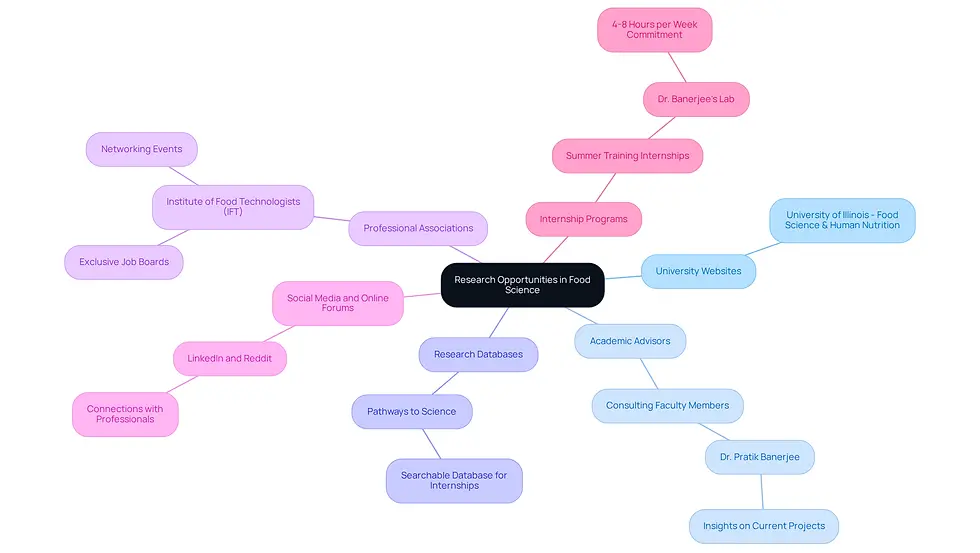
Students often struggle with how to find food science research opportunities as an undergraduate without the right resources. To discover food science research opportunities, students can leverage several key resources:
University Websites: Many institutions have specific sections for undergraduate projects. For example, the Food Science & Human Nutrition department at the University of Illinois provides an extensive list of available projects, facilitating the process for learners to discover pertinent opportunities.
Academic Advisors: Consulting academic advisors or faculty members is crucial. Dr. Pratik Banerjee emphasizes, "Students should consult their academic advisors or faculty members who can provide insights into current projects and potential openings in their labs." This guidance can assist learners in navigating their options effectively.
Research Databases: Platforms such as Pathways to Science offer searchable databases specifically for internships and scholarly pursuits in food science and related fields, assisting students in locating positions that align with their interests.
Professional Associations: Becoming a member of groups like the Institute of Food Technologists (IFT) provides entry to exclusive job boards and networking events, which can be vital in discovering avenues for investigation.
Social Media and Online Forums: Utilizing platforms like LinkedIn and Reddit can facilitate connections with professionals in the field, providing insights into informal inquiry opportunities that may not be widely advertised.
Internship Programs: Many universities and organizations provide summer training internships, enabling individuals to acquire practical experience in food science laboratories. For instance, the usual dedication for projects in Dr. Banerjee's lab is 4-8 hours each week for over one semester, offering learners valuable experience.
By using these resources and staying informed about ongoing projects through seminars and newsletters, students can discover how to find food science research opportunities as an undergraduate that align with their academic interests and career goals. Deliverables from these experiences may include short video series and White Papers, further enhancing their academic portfolio. Without leveraging these resources, students risk missing out on valuable experiences that could shape their careers.
Connect with Faculty and Engage in Research Projects
Building strong relationships with faculty is essential for undergraduates seeking to engage in meaningful project work. Here are effective steps to connect with faculty, supported by Coltie's innovative platform:
Attend Office Hours: Regularly visit faculty during their office hours to discuss their areas of interest and express enthusiasm for their work. Such interactions can strengthen connections, particularly with the help of Coltie's communication tools.
Participate in Class: Actively engage in class discussions and ask insightful questions. This not only helps you stand out but also demonstrates your genuine interest in the subject matter, which Coltie encourages through its student-centered approach.
Email Faculty: Create a brief and courteous email introducing yourself, outlining your academic background, and expressing interest in their work. Be specific about what aspects of their work intrigue you, as personalized communication increases engagement. Remember to address the individual by name to personalize the email.
Volunteer for Projects: Offer to assist with ongoing study projects, even on a volunteer basis. This proactive method can result in more formal scholarly opportunities in the future, as many faculty members value individuals willing to contribute. As Professor Amanda Cappon observes, "On average, individuals identified 3.91 obstacles to their involvement in studies but averaged 9.28 advantages, so it’s clear they recognize that there are disproportional benefits to engaging in studies." Despite recognizing obstacles, students see significant advantages in engaging with faculty.
Network at Events: Participate in departmental seminars, workshops, and networking gatherings to connect with faculty and other individuals engaged in scholarly activities. These interactions can provide insights into potential openings and help you build valuable connections, further enhanced by Coltie's event management features.
Follow Up: After initial meetings or communications, send a thank-you note or email. This gesture shows appreciation and keeps the lines of communication open, reinforcing your interest in their work.
Many students recognize the benefits of participating in studies, noting improvements in their resumes and career prospects. For example, 84.38% of learners think that experiential learning will assist them in their future careers, as emphasized by Professor Cappon. This engagement not only enriches academic experiences but also paves the way for future career opportunities. Ultimately, these connections can significantly influence students' academic and professional trajectories.

Prepare Your Profile and Skills for Research Applications
To secure a food science research opportunity, candidates must effectively prepare their profiles and skills:
Create a Strong Resume: Highlight relevant coursework, skills, and any prior experiences from internships or projects. Customize your resume to showcase your enthusiasm for culinary science and ensure it aligns with the specific job criteria.
Create an Engaging Cover Letter: Compose a cover letter that expresses your enthusiasm for food science, highlights your academic accomplishments, and describes your interest in the specific opportunity. A strong cover letter can greatly influence your application; 45% of recruiters indicate that not including one may result in rejection.
Create a Portfolio: If relevant, assemble a portfolio showcasing any projects, presentations, or scholarly papers you have completed. This tangible evidence of your skills and interests can set you apart from other candidates.
Enhance Your Skills: Consider additional courses or workshops to enhance your investigative skills, including statistics, laboratory techniques, and data analysis. Demonstrating a commitment to continuous learning can strengthen your profile.
Seek Recommendations: Obtain letters of recommendation from professors or professionals who can speak to your abilities and potential as a researcher. Ensure they are familiar with your work and can provide specific examples of your strengths, as personalized recommendations can significantly enhance your application.
Practice Interview Skills: Prepare for possible interviews by rehearsing typical questions related to your academic interests and experiences. Be ready to discuss your motivations and how you can add value to the team, as effective communication is a vital skill desired by employers.
By taking these steps, students can present themselves as well-rounded candidates, which can help them understand how to find food science research opportunities as an undergraduate. Ultimately, a well-prepared application can be crucial for understanding how to find food science research opportunities as an undergraduate.

Conclusion
Navigating the landscape of food science research opportunities is crucial for undergraduates seeking to enhance their academic and professional journeys. By understanding how to find these opportunities, students not only cultivate invaluable skills but also build essential networks and gain practical experience that prepares them for a competitive job market.
Key insights include:
The significance of skill development
The importance of networking with faculty and industry professionals
The benefits of experiential learning
Utilizing resources such as university websites, academic advisors, and professional associations can greatly aid students in discovering relevant research opportunities. Furthermore, establishing strong relationships with faculty and preparing a compelling application profile are critical steps in securing these positions.
Many students find it challenging to navigate the landscape of food science research opportunities. Without these experiences, students may find themselves at a disadvantage in the competitive job market. The proactive pursuit of research opportunities can be the differentiating factor that shapes a successful career in culinary science. Undergraduates are encouraged to take proactive steps in seeking out these opportunities, as the knowledge and experiences gained will significantly shape their professional trajectories in the dynamic field of culinary science. Embracing these avenues can lead to a rewarding and impactful career, making the effort to engage in research an invaluable investment in their futures.
Frequently Asked Questions
Why is it important for undergraduates in food science to seek research opportunities?
Seeking research opportunities is important for undergraduates in food science because it enhances their academic and professional prospects by developing critical skills, providing networking opportunities, improving learning, preparing them for careers, and fostering personal growth.
What skills can students develop by engaging in food science research?
Students can develop skills such as analytical thinking, problem-solving, and technical expertise in scientific methodologies related to nutrition.
How do research projects help with networking?
Research projects often involve collaboration with faculty and industry professionals, allowing students to establish valuable connections that can lead to internships and job placements.
In what way does research improve learning for food science students?
Research allows students to apply classroom knowledge to real-world challenges, deepening their understanding of culinary science concepts and practices through experiential learning.
How does research experience impact employability in the food industry?
Many employers in the food industry prioritize applicants with research experience, making it a valuable asset on resumes and enhancing employability by providing relevant experience aligned with industry expectations.
What personal benefits do students gain from participating in research?
Participation in research fosters independence, confidence, and a sense of accomplishment, contributing to both personal and professional development.
What are the potential consequences of not having research experience for undergraduates?
Without research experience, undergraduates may struggle to stand out in a competitive job market, which can hinder their ability to secure desirable positions in the food industry.
List of Sources
Understand the Importance of Food Science Research Opportunities The Institute for the Advancement of Food & Nutrition Sciences is Now Accepting Applications for Summer Research Opportunity Fellowships | Newswise (https://newswise.com/articles/the-institute-for-the-advancement-of-food-nutrition-sciences-is-now-accepting-applications-for-summer-research-opportunity-fellowships3) Observations on the use of statistical methods in Food Science and Technology (https://sciencedirect.com/science/article/abs/pii/S0963996913005723) Making Sense of the Numbers: Statistics for Food Scientists – Rutgers NJAES Office of Continuing Professional Education (https://cpe.rutgers.edu/food-science-safety/statistics-for-food-scientists) Food Research Institute accepting applications for 2026 Summer Undergraduate Research Program in Food Safety – eCALS (https://ecals.cals.wisc.edu/2025/10/02/food-research-institute-accepting-applications-for-2026-summer-undergraduate-research-program-in-food-safety) Research | Food Systems, Nutrition, and Health (https://foodsystems.uw.edu/undergraduate/foodsystems/experiential-learning/research)
Explore Available Resources for Research Opportunities News | Food Science & Human Nutrition | UIUC (https://staging.fshn.illinois.edu/news) The Institute for the Advancement of Food & Nutrition Sciences is Now Accepting Applications for Summer Research Opportunity Fellowships | Newswise (https://newswise.com/articles/the-institute-for-the-advancement-of-food-nutrition-sciences-is-now-accepting-applications-for-summer-research-opportunity-fellowships2) Undergraduate Research | Food Science & Human Nutrition | Illinois (https://fshn.illinois.edu/current-students/undergraduate-research)
Connect with Faculty and Engage in Research Projects Tips for Writing an Email to Faculty about Research | Office for Undergraduate Research (https://our.unc.edu/find/emails-to-faculty) Guest Post: Tips on Emailing a Professor to Ask for a Research (https://undergradinthelab.com/node/203) Undergraduate Research | Food Science & Human Nutrition | Illinois (https://fshn.illinois.edu/current-students/undergraduate-research) The Do’s and Don’ts of Contacting Professors about Research | SENR (https://senr.osu.edu/undergraduate/undergraduate-research/dos-and-donts) Engaging Students in Research (https://facultyfocus.com/articles/course-design-ideas/engaging-students-in-research)
Prepare Your Profile and Skills for Research Applications Food Scientist Cover Letter Examples (https://livecareer.com/cover-letter/examples/food-service/food-scientist) How to Write a Good Cover Letter for a Research Position | Earthlab (https://earthlab.colorado.edu/blog/how-write-good-cover-letter-research-position) Cover Letter Tips for Beginning Food Scientists - My Food Job Rocks! (https://myfoodjobrocks.com/cover-letters-for-beginning-food-scientists) What do you do if your cover letter isn't grabbing the attention of Food Science employers? (https://linkedin.com/advice/0/what-do-you-your-cover-letter-isnt-grabbing-attention-iayrf) 165 Resume Statistics: Cover Letters and Valuable Skills (https://flair.hr/en/blog/resume-statistics)



Comments