

4 Best Practices for a Faculty Research Profile to Boost Opportunities

Introduction
Creating a compelling faculty research profile is essential for enhancing visibility and fostering new academic opportunities. By incorporating key elements such as a clear biography, detailed study focus, and engaging video content, faculty members can effectively showcase their scholarly identity and attract potential collaborators.
However, many educators struggle to keep their profiles updated amidst constant changes in research focus and academic trends. This article will explore effective strategies for creating and maintaining a faculty research profile that highlights achievements and fosters meaningful academic connections.
Establish Essential Components of a Faculty Research Profile
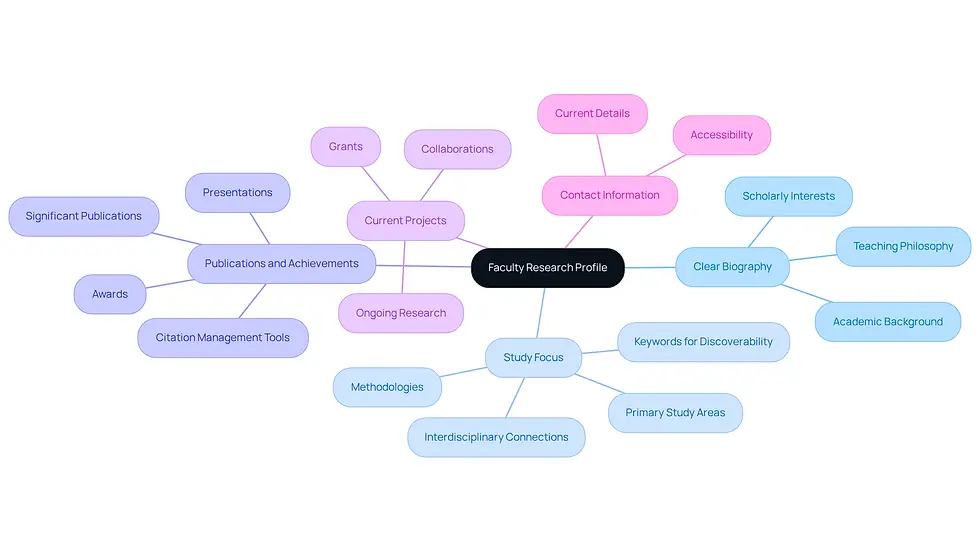
To effectively communicate your scholarly identity, a well-structured faculty research profile is essential. Several key components must be included:
Clear Biography: Begin with a concise biography that outlines your academic background, scholarly interests, and teaching philosophy. Use straightforward language to ensure accessibility and avoid jargon.
Study Focus: Clearly articulate your primary study areas, including specific topics, methodologies, and interdisciplinary connections. Incorporate commonly searched keywords in your field to enhance discoverability.
Publications and Achievements: List significant publications, presentations, and awards. This not only showcases your contributions but also establishes credibility. Utilizing a citation management tool can help keep track of your work effectively.
Current Projects: Include details about ongoing research projects, grants, or collaborations. This shows your active engagement in research and can attract potential collaborators, fostering a collaborative academic environment.
Contact Information: Ensure that your contact details are current and easily accessible. This encourages communication from students and colleagues interested in your work.
By including these components, faculty members can develop a robust faculty research profile for research opportunity discovery and enhance their professional visibility. Significantly, modern researchers are increasingly anticipated to have additional skills beyond research excellence, such as collaboration and digital literacy, which can further enhance their qualifications. For example, a case study emphasized that applicants who exhibit teaching experience and community engagement greatly improve their educational profiles, demonstrating leadership and dedication. As John Fedrick noted, "Although earning a degree is a significant accomplishment, it is really just the beginning of a much longer academic and professional journey." Ultimately, a well-crafted profile not only enhances visibility but also opens doors to new academic opportunities.
Incorporate Video Content to Enhance Profile Engagement
To maximize the impact of video content in your faculty research profile, it is crucial to adopt effective strategies:
Video Introductions: Create a brief introductory video discussing your academic interests, teaching philosophy, and what excites you about your work. This personal touch helps build connections with prospective students and collaborators, boosting engagement. Including personal information, such as hobbies or experiences, can further strengthen this connection. Coltie's platform allows you to showcase these introductions effectively, making it easier for students to find the right fit.
Study Summaries: Utilize video abstracts to succinctly summarize your findings or ongoing projects. These videos can break down complex topics, making them easier for a wider audience to understand, which is vital for clear communication in academia. Coltie's intelligent matching system can assist in linking students with projects that align with their interests.
Teaching Demonstrations: Include videos showcasing your teaching methods or lectures, if applicable. This not only highlights your teaching style but also provides insight into your educational approach, reinforcing your presence and effectiveness as an instructor. Shorter videos, ideally less than six minutes, are more effective for student engagement. Coltie encourages faculty to improve their presentations with such content to attract prospective students by leveraging their faculty research profile for research opportunity discovery.
Engagement with Current Trends: However, many educators struggle to keep their content updated and engaging. Regularly updating your video content to reflect current research trends or recent achievements is essential for maintaining interest and engagement among viewers. Coltie's platform supports continuous updates, ensuring that your account remains dynamic and engaging.
Utilize Platforms: Host your videos on platforms like YouTube or Vimeo and embed them in your account. Ensure they are easily accessible and optimized for mobile viewing, as video content is increasingly consumed on mobile devices. Pay attention to technical aspects such as microphone quality and lighting to avoid common pitfalls that can detract from the video quality. Coltie enables this integration, making it effortless for educators to improve their presentations.
By implementing these strategies, educators can significantly enhance their academic presence and connection with students, ultimately transforming how educators engage with students and fostering a more interactive academic environment.

Regularly Update and Maintain Your Research Profile
To maintain an impactful faculty research profile, regular updates are essential. Implement the following best practices for effective updates:
Set a Schedule: Establish a routine for reviewing and updating your account, ideally on a quarterly or biannual basis. This practice keeps your information current and comprehensive, showcasing your latest achievements. Regular updates significantly enhance visibility and collaboration opportunities, supporting Coltie's mission to strengthen connections between students and instructors by utilizing a faculty research profile for research opportunity discovery.
Track Achievements: Maintain a detailed record of your publications, presentations, and other professional activities as they occur. This proactive approach simplifies the updating process, ensuring that no significant accomplishments are overlooked. Tools like Google Scholar Profiles can automatically track citations, helping you monitor your impact over time.
Solicit Feedback: Periodically ask colleagues or mentors to review your information. Their insights can highlight areas for improvement and provide valuable perspectives that you might miss. Public awareness of faculty accomplishments can lead to important opportunities for collaboration and recognition, further enhancing the visibility that Coltie aims to provide.
Engage with New Technologies: Stay informed about emerging tools and platforms that can enhance your presence. Incorporating new citation metrics or impact indicators can significantly enhance your visibility and engagement. Platforms such as Web of Science and ORCID provide real-time updates that maintain your account's relevance, ensuring you utilize Coltie's features effectively.
Reflect Changes in Research Focus: As your research interests evolve, ensure that your information accurately represents these changes. This alignment is crucial for attracting the right collaborators and opportunities. Keeping current staff information improves recruitment initiatives and encourages interdisciplinary partnerships.
By committing to regular updates, educators can sustain a dynamic presence that accurately reflects their scholarly contributions. Ultimately, a well-maintained profile can open doors to new collaborations and enhance institutional reputation.

Leverage Networking Opportunities to Expand Research Collaborations
To expand research collaborations effectively, researchers must navigate various networking opportunities that can significantly enhance their professional connections. Consider the following strategies:
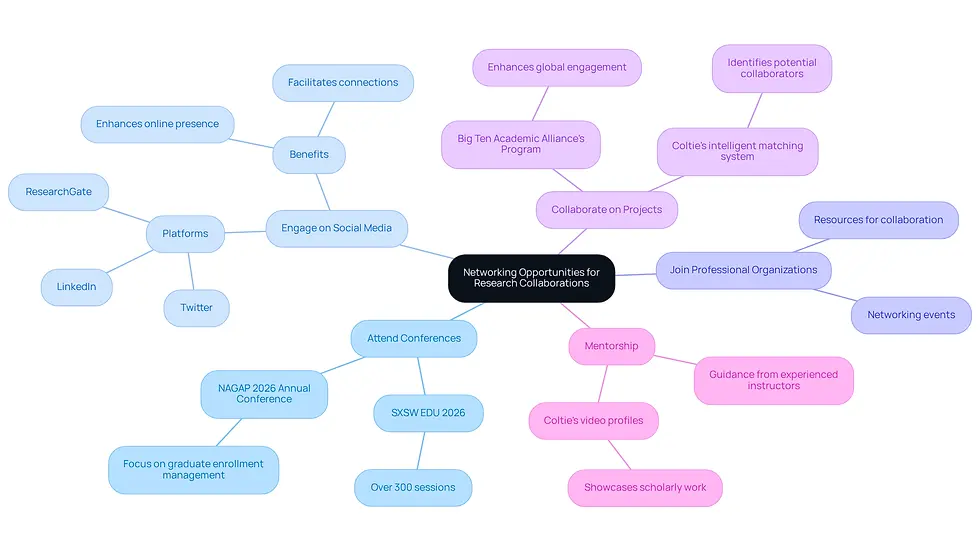
Attend Conferences: Participate in professional conferences and workshops relevant to your field. These events are crucial for connecting with potential partners and disseminating findings. For instance, the upcoming SXSW EDU 2026 will feature over 300 sessions, providing ample networking opportunities for educators and researchers alike.
Engage on Social Media: Utilize platforms such as LinkedIn, ResearchGate, and Twitter to connect with fellow researchers. Sharing your work, participating in discussions, and following trends in your field can significantly enhance your online presence and facilitate connections.
Join Professional Organizations: Become a member of relevant scholarly associations. These organizations frequently host networking events and provide resources that foster collaboration. For example, the NAGAP 2026 Annual Conference will focus on graduate enrollment management, offering a platform for networking among professionals in the field.
Collaborate on Projects: Actively seek opportunities to collaborate on research projects with colleagues from your institution or beyond. Collaborative projects not only result in shared publications but also enhance visibility within the scholarly community. The Big Ten Academic Alliance's Professional Development Program on Internationalization exemplifies how collaborative efforts can enhance global engagement. Additionally, leveraging Coltie's intelligent matching system can help identify potential collaborators based on shared interests and expertise, streamlining the process of finding suitable partners.
Mentorship: Seek guidance from experienced instructors who can provide support and connect you with their networks. Establishing connections with mentors can unlock new opportunities and improve your educational journey. Coltie's video profiles enable instructors to display their scholarly work and advising approaches, facilitating connections for potential students and collaborators.
By embracing these strategies, researchers can not only broaden their collaborative networks but also elevate their contributions to the academic community.
Conclusion
In a competitive academic landscape, a well-crafted faculty research profile is essential for visibility and opportunity. A well-structured profile serves as a vital tool for academics seeking to enhance their visibility and open doors to new opportunities. Incorporating essential components like a clear biography, detailed study focus, and a comprehensive list of publications helps faculty members communicate their scholarly identity and attract collaborators.
Key strategies include:
Integrating engaging video content
Regularly updating profiles to maintain relevance
Leveraging networking opportunities to expand research collaborations
Each of these elements plays a crucial role in fostering connections within the academic community and enhancing the overall impact of a research profile. By actively participating in conferences, utilizing social media, and seeking mentorship, researchers can significantly broaden their professional networks and elevate their contributions to their fields.
Maintaining an updated and engaging faculty research profile is crucial for academic success. By focusing on these strategies, academics can enhance their profiles and foster innovation and collaboration in their fields.
Frequently Asked Questions
What is the purpose of a faculty research profile?
A faculty research profile is essential for effectively communicating your scholarly identity and enhancing professional visibility.
What should be included in a clear biography for a faculty research profile?
A clear biography should outline your academic background, scholarly interests, and teaching philosophy using straightforward language to ensure accessibility.
How can I articulate my study focus in my research profile?
Clearly articulate your primary study areas, including specific topics, methodologies, and interdisciplinary connections, while incorporating commonly searched keywords in your field to enhance discoverability.
Why is it important to list publications and achievements in a research profile?
Listing significant publications, presentations, and awards showcases your contributions and establishes credibility in your field.
What should I include about current projects in my faculty research profile?
Include details about ongoing research projects, grants, or collaborations to demonstrate your active engagement in research and attract potential collaborators.
How important is contact information in a faculty research profile?
Ensuring that your contact details are current and easily accessible encourages communication from students and colleagues interested in your work.
What additional skills are modern researchers expected to have beyond research excellence?
Modern researchers are increasingly expected to possess skills such as collaboration and digital literacy, which can enhance their qualifications.
How can teaching experience and community engagement impact a faculty research profile?
Exhibiting teaching experience and community engagement can greatly improve educational profiles, demonstrating leadership and dedication.
What is the overall benefit of having a well-crafted faculty research profile?
A well-crafted profile enhances visibility and opens doors to new academic opportunities.
List of Sources
Establish Essential Components of a Faculty Research Profile How to Build a Strong Academic Profile: A Complete Guide for Aspiring Researchers (https://globalxpublications.com/blog/how-to-build-a-strong-academic-profile) February 2026 - Research Updates and News, AI in Higher Ed, Faculty-Development Trends, 2026 Higher Education Trends, and More - AACRAO (https://aacrao.org/news/february-2026-research-updates-and-news-ai-in-higher-ed-faculty-development-trends-2026-higher-education-trends-and-more) Data Snapshot: Women Faculty and Faculty of Color, Fall 2023 (https://aaup.org/academe/issues/fall-2025/data-snapshot-women-faculty-and-faculty-color-fall-2023) Creating Effective Faculty Profiles: Elevating Research Visibility and University Impact (https://provost.ncsu.edu/ofe/2025/04/30/creating-effective-faculty-profiles-elevating-research-visibility-and-university-impact)
Incorporate Video Content to Enhance Profile Engagement Making a First Impression With Your Introduction Videos | Quality Matters (https://qualitymatters.org/qa-resources/resource-center/articles-resources/how-to-make-video-introductions) Top 7 Social Media Updates for Higher Ed As 2026 Begins (https://keg.com/news/7-social-media-changes-for-2026) Teaching Online? Introduce Yourself with a Video | U-M LSA LSA Technology Services (https://lsa.umich.edu/technology-services/news-events/all-news/teaching-tip-of-the-week/teaching-online--introduce-yourself-with-a-video.html) How Video Makes Learning Engaging and Personal in Higher Ed (https://d2l.com/blog/how-video-makes-learning-engaging-and-personal-in-higher-ed)
Regularly Update and Maintain Your Research Profile Research Guides: Research Impact Resources and Services: Research and Scholarly Profiles (https://researchguides.library.syr.edu/researchimpact/profiles) 6 reasons to use Faculty Success (formerly Digital Measures) to power faculty web profiles (https://watermarkinsights.com/resources/blog/6-reasons-to-use-faculty-success-formerly-digital-measures-to-power-faculty-web-profiles) How often does Google Scholar update citation counts? (https://ideophone.org/how-often-does-google-scholar-update) Creating Effective Faculty Profiles: Elevating Research Visibility and University Impact (https://provost.ncsu.edu/ofe/2025/04/30/creating-effective-faculty-profiles-elevating-research-visibility-and-university-impact) Academia.edu Statistics – Understanding Your Research Visibility and Performance – Scientific News (https://news.europub.co.uk/academia-edu-statistics-understanding-your-research-visibility-and-performance)
Leverage Networking Opportunities to Expand Research Collaborations Top Higher Education Conferences in to Put on Your Radar (https://educationdynamics.com/higher-education-conferences-to-put-on-your-radar) The Importance of Academic Conferences (https://blog.mdpi.com/2026/04/15/the-importance-of-academic-conferences) Conference cancellations could have ‘big impact’ on research (https://timeshighereducation.com/news/conference-cancellations-could-have-big-impact-research) 2026 Higher Ed Conference Calendar (https://keg.com/news/2026-higher-ed-conference-calendar?hs_amp=true) News (https://btaa.org/about/news)



Comments