

Understanding Human-Computer Interaction Research Opportunities for Undergraduates

Updated: Jun 22
Introduction
Understanding the complexities of Human-Computer Interaction (HCI) is essential for undergraduates seeking to excel in this dynamic field. With technology woven into the fabric of daily life, grasping the intricacies of user interaction is crucial for crafting impactful digital experiences. This article outlines various research avenues in HCI for students, emphasizing the skills acquired and their significance for future career trajectories.
Aspiring researchers must navigate various challenges to fully leverage these opportunities and influence the future of technology. Successfully addressing these challenges can profoundly impact both technological progress and career outcomes in HCI.
Define Human-Computer Interaction Research Opportunities
The study of Human-Computer Interaction (HCI) presents both opportunities and challenges for students navigating the complexities of technology. HCI encompasses a wide range of academic and practical paths, allowing students to explore user experience (UX), user interface (UI) design, accessibility, and the broader societal implications of technology. HCI draws from computer science, psychology, design, and social sciences, creating a rich environment for innovation.
In 2026, an increasing number of universities are offering HCI study programs, reflecting the growing recognition of its importance in academia. For instance, the Research Experience for Undergraduates program at Carnegie Mellon University provides a 10-week paid opportunity for students to engage in HCI studies, collaborating on significant projects with leading scholars. Participants in this program often contribute to advancements in areas such as educational innovations, privacy tools, and accessibility solutions.
Many experts emphasize the importance of human computer interaction research opportunities for undergraduates. Cuong Nguyen, a Research Scientist, notes, "With more advanced sensing in head-mounted displays, we could provide users improved capabilities," highlighting HCI's potential to drive future innovations. This underscores the essential skills that students develop through HCI studies, equipping them to navigate the complexities of innovation in society. As technology continues to advance, the demand for skilled professionals in HCI will only increase, shaping the future of user interaction.

Contextualize HCI Research in Modern Academia and Technology
In an era where technology permeates every aspect of life, the study of Human-Computer Interaction (HCI) is crucial for optimizing user experiences with digital systems. As advancements become increasingly integrated into daily life, understanding user behavior and preferences is essential for creating effective and user-friendly interfaces. Contemporary academia acknowledges this necessity, resulting in the creation of specialized HCI programs and centers at universities, such as the Center for Human-Computer Interaction + Design at Northwestern University. These programs equip students for careers in technology and promote ethical and inclusive innovations.
The emergence of artificial intelligence, virtual reality, and pervasive computing further emphasizes the need for strong HCI studies. Without a deep understanding of human interaction, achieving success with these advancements becomes increasingly difficult. Institutions prioritizing HCI create user-centered designs that enhance customer satisfaction and loyalty. This focus positions them as leaders in the tech industry.
Based on recent studies, 64% of organizations have incorporated aspects in their work-related AI strategy that stress the significance of HCI, underscoring its vital role in influencing the future of innovation. The integration of HCI principles is not just beneficial; it is essential for organizations aiming to lead in innovation and user satisfaction.

Trace the Origins and Evolution of HCI Research
The evolution of Human-Computer Interaction (HCI) reflects a significant shift in how users engage with technology, moving from command-line interfaces to more accessible graphical user interfaces.
Initially, users faced challenges due to the need for specific text commands, which limited their ability to engage with technology effectively. However, as personal computing became more widespread, this transition allowed a broader audience to engage with technology, fostering inclusivity and ease of use. Pioneering figures like Douglas Engelbart and Ivan Sutherland played a vital role in this transition, advocating for usability and user-centered design principles that remain foundational to HCI today.
Over the years, HCI has expanded to encompass various subjects, including mobile computing, accessibility, and advancements in artificial intelligence. The introduction of touchscreens in the late 20th century, particularly with the launch of Apple's iPhone in 2007, revolutionized user interactions by enabling direct physical contact with devices. This shift not only enhanced usability but also set new standards for mobile computing, leading to the development of multi-modal interfaces that combine touch, voice, and gesture inputs.
Research in HCI has consistently progressed, mirroring the intricacies of contemporary advancements and user interactions. Significant progress includes the emergence of immersive innovations like augmented reality (AR) and virtual reality (VR), which have transformed educational settings and user experiences. As technology continues to evolve, understanding HCI will be crucial for developing interfaces that meet the needs of diverse users.

Identify Key Characteristics of HCI Research Opportunities
In the rapidly evolving field of Human-Computer Interaction (HCI), human computer interaction research opportunities for undergraduates are defined by a commitment to interdisciplinary collaboration and practical experience.
Key Characteristics of HCI Opportunities:
Interdisciplinary collaboration
Hands-on experience
User-centered design approach
Students are encouraged to engage with faculty and industry professionals, which fosters a collaborative environment that enhances their learning experience. These opportunities frequently entail practical projects that allow learners to apply theoretical knowledge to real-world issues, such as designing user-friendly interfaces or conducting usability testing.
Research indicates that hands-on learning can lead to performance improvements of up to 20% compared to traditional methods, enhancing creativity, critical thinking, and problem-solving skills. Interdisciplinary collaboration is essential in HCI research, as it provides human computer interaction research opportunities for undergraduates to explore diverse perspectives and develop innovative solutions to complex challenges. This collaborative approach not only prepares students for various career paths but also fosters innovation in technology and design, instilling a strong ethical framework that ensures technology serves the diverse needs of users and promotes accessibility. Integrating multiple viewpoints enables learners to gain a broader understanding of the field, essential for addressing the industry's evolving demands. Ultimately, this comprehensive approach ensures that future professionals are equipped to meet the diverse needs of users in an increasingly complex technological landscape.

Present Examples of HCI Research Opportunities for Undergraduates
Many students encounter difficulties in navigating the diverse opportunities available in Human-Computer Interaction (HCI) studies, yet numerous universities provide enriching pathways to success.
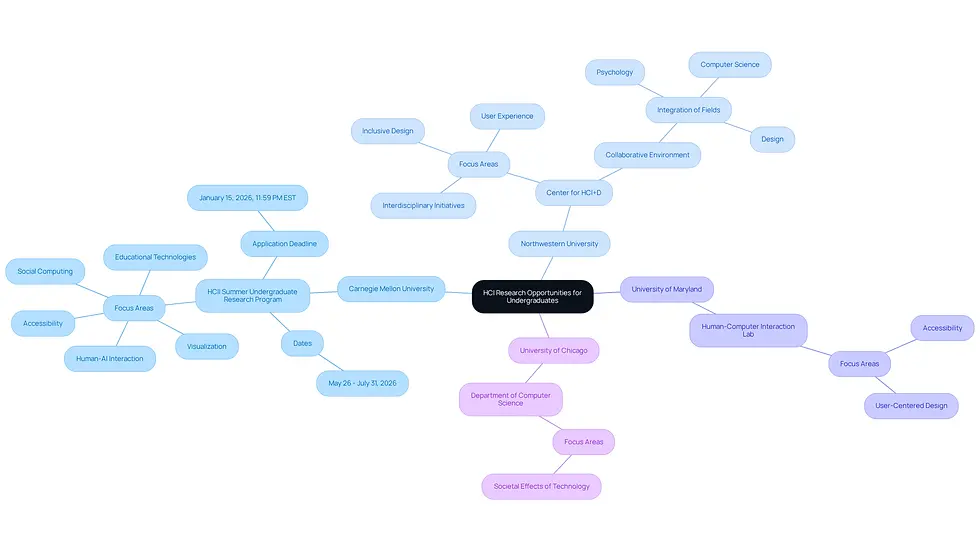
The Human-Computer Interaction Institute (HCII) at Carnegie Mellon University offers a Summer Undergraduate Research Program from May 26 to July 31, 2026. This program provides hands-on experience and creates opportunities for publication and professional development, with an application deadline of January 15, 2026, at 11:59 PM EST. Participants collaborate on innovative projects with esteemed faculty and researchers, ensuring they are well-prepared to address practical challenges in technology and design.
Similarly, Northwestern University's Center for Human-Computer Interaction + Design (HCI+D) emphasizes inclusive design and user experience through various interdisciplinary initiatives that integrate psychology, computer science, and design. This collaborative environment equips learners for impactful careers in HCI.
Other notable programs include:
The University of Maryland's Human-Computer Interaction Lab, which focuses on accessibility and user-centered design.
The University of Chicago's Department of Computer Science, where projects explore the societal effects of technology.
These initiatives illustrate the varied human-computer interaction research opportunities for undergraduates, enabling individuals interested in HCI exploration to acquire valuable experience and contribute to important advancements in the field.
Research shows that getting involved in HCI projects can really boost your career prospects, with many graduates securing roles in top technology firms or pursuing advanced degrees. Adam Perer, the HCII REU faculty director, emphasizes that the program aims to provide participants with real-world experience in HCI research. The collaborative nature of these programs ultimately prepares students for immediate career opportunities and lays the groundwork for long-term professional growth in the evolving field of HCI.
Conclusion
The dynamic field of Human-Computer Interaction (HCI) research offers undergraduates a unique opportunity to shape the future of technology. However, many students remain unaware of how HCI can directly impact their future careers. By engaging in HCI studies, students enhance their understanding of user experience and interface design while contributing to innovations that address real-world challenges. More universities are recognizing the importance of HCI, offering specialized programs that prepare students for this exciting field.
Key insights highlight the importance of:
Hands-on experience
Interdisciplinary collaboration
User-centered design in HCI research
Programs such as those at Carnegie Mellon University and Northwestern University exemplify how students can immerse themselves in practical projects that foster creativity and critical thinking. The evolution of HCI, from command-line interfaces to modern touch and voice interactions, illustrates the field's adaptability and relevance in an ever-changing technological landscape.
This preparation is vital as the digital landscape continues to evolve rapidly. As technology advances, the demand for skilled professionals in HCI will only grow. Engaging in these research opportunities not only enhances career prospects but also empowers future innovators to create inclusive and effective technological solutions. As the digital landscape evolves, those equipped with HCI expertise will be at the forefront of creating solutions that truly resonate with users.
Frequently Asked Questions
What is Human-Computer Interaction (HCI)?
Human-Computer Interaction (HCI) is the study of how people interact with computers and technology, encompassing areas such as user experience (UX), user interface (UI) design, accessibility, and the societal implications of technology.
What opportunities are available for students studying HCI?
Students studying HCI can engage in various academic and practical paths, including programs like the Research Experience for Undergraduates at Carnegie Mellon University, which offers a 10-week paid opportunity to work on significant HCI projects.
Why is HCI important in modern academia and technology?
HCI is crucial for optimizing user experiences with digital systems, as it helps understand user behavior and preferences, which is essential for creating effective and user-friendly interfaces.
How are universities responding to the demand for HCI studies?
An increasing number of universities are offering specialized HCI programs and centers, reflecting the growing recognition of its importance in academia and the tech industry.
What role does HCI play in the development of new technologies?
HCI plays a vital role in the development of new technologies, such as artificial intelligence and virtual reality, by ensuring that user-centered designs enhance customer satisfaction and loyalty.
What percentage of organizations incorporate HCI in their AI strategies?
Recent studies indicate that 64% of organizations have integrated aspects of HCI into their work-related AI strategies, highlighting its significance in influencing future innovation.
What skills do students develop through HCI studies?
Students develop essential skills that equip them to navigate the complexities of innovation in society, preparing them for careers in technology and promoting ethical and inclusive innovations.
List of Sources
Define Human-Computer Interaction Research Opportunities Human-computer interaction | MIT News | Massachusetts Institute of Technology (https://news.mit.edu/topic/human-computer-interaction) Human–Computer Interaction (https://nationalacademies.org/topics/human-computer-interaction) Research trends: What’s next for human-computer interaction in the metaverse and beyond (https://research.adobe.com/news/research-trends-whats-next-for-human-computer-interaction-in-the-metaverse-and-beyond) HCII Summer Undergraduate Research Program | Human-Computer Interaction Institute (https://hcii.cmu.edu/summer-research-program)
Contextualize HCI Research in Modern Academia and Technology 5 Predictions on How AI Will Shape Higher Ed in 2026 (https://insidehighered.com/news/tech-innovation/artificial-intelligence/2026/01/05/5-predictions-how-ai-will-shape-higher-ed) The Significance of Human-Computer Interaction in Today’s Ever-Evolving Tech Industry (https://hub.fullsail.edu/articles/the-significance-of-human-computer-interaction-in-todays-ever-evolving-tech-industry) News & Events: Human-Computer Interaction + Design Center - Northwestern University (https://hci.northwestern.edu/news-events) The Impact of AI on Work in Higher Education (https://educause.edu/research/2026/the-impact-of-ai-on-work-in-higher-education) Human-Computer Interaction Market Report 2026 - Research and Markets (https://researchandmarkets.com/reports/5972808/human-computer-interaction-market-report?srsltid=AfmBOop6YQNNyaGowQyBaccfi7pdyB1di5bbnGH8fMy-_f1IgW56F4cV)
Trace the Origins and Evolution of HCI Research The Evolution of Human-computer Interaction (https://hilarispublisher.com/open-access/the-evolution-of-humancomputer-interaction-103009.html) The History Of Human-Computer Interaction (https://quantumzeitgeist.com/the-history-of-human-computer-interaction-from-command-line-to-touch-and-voice) Human Computer Interaction - brief intro (https://ixdf.org/literature/book/the-encyclopedia-of-human-computer-interaction-2nd-ed/human-computer-interaction-brief-intro) Myers Awarded 2025 CBI Human-Computer Interaction History Prize (https://cse.umn.edu/cbi/news/myers-awarded-2025-cbi-human-computer-interaction-history-prize)
Identify Key Characteristics of HCI Research Opportunities Interdisciplinary Collaboration Yields Greater Impact (https://medicine.yale.edu/news-article/interdisciplinary-collaboration-yields-greater-impact) Human-Computer Interaction Institute (HCII) Summer Undergraduate Research Program | Undergraduate Research Opportunities | Illinois (https://researchops.web.illinois.edu/opportunity/human-computer-interaction-institute-hcii-summer-undergraduate-research-program) 5 Benefits Of Interdisciplinary Collaboration In Graduate Research - GradSchoolHub.com (https://gradschoolhub.com/lists/5-benefits-of-interdisciplinary-collaboration-in-graduate-research) Teaming Up for Discovery: How Interdisciplinary Collaboration Bolsters Innovative Research Efforts | Center for Clinical and Translational Science (https://uab.edu/ccts/news-events/center-news/teaming-up-for-discovery-how-interdisciplinary-collaboration-bolsters-innovative-research-efforts) CASE for Hands-On Learning - Education Associates (https://educationassociates.com/case-for-hands-on-learning)
Present Examples of HCI Research Opportunities for Undergraduates DUB REU Program Summer 2026 (https://dub.washington.edu/reu.html) Human-Computer Interaction + Design Center - Northwestern University (https://hci.northwestern.edu) HCII Seeks Applicants for 2026 Summer Research Program | Human-Computer Interaction Institute (https://hcii.cmu.edu/news/hcii-seeks-applicants-2026-summer-research-program) HCII Summer Undergraduate Research Program | Human-Computer Interaction Institute (https://hcii.cmu.edu/summer-research-program) Human Computer Interaction - Department of Computer Science (https://cs.uchicago.edu/research/human-computer-interaction)


Comments