

4 Best Practices to Enhance Materials Science Research Experience for College Students

Updated: Jun 15
Introduction
In the rapidly evolving field of materials science, many educational institutions struggle to adapt their curricula to meet evolving student needs. By integrating research opportunities into the curriculum, fostering intentional mentorship, leveraging technology, and emphasizing experiential learning, institutions can significantly enhance the research experience for college students. If educators fail to adapt, students may find themselves ill-equipped to thrive in a competitive job market.
Integrate Research Opportunities into Curriculum
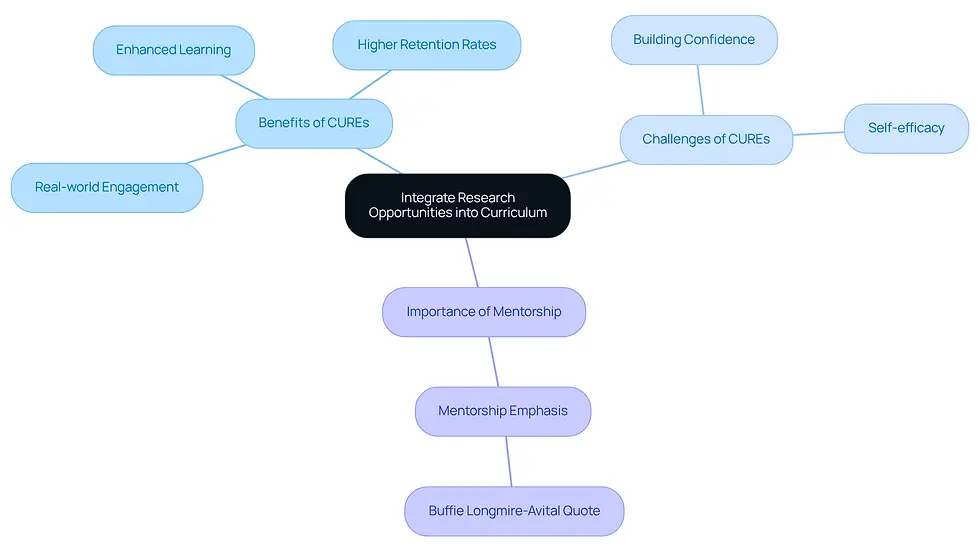
Incorporating investigation opportunities into the curriculum presents both challenges and opportunities for enhancing materials science education. Implementing Course-based Undergraduate Research Experiences (CUREs) allows learners to engage in real-world projects, effectively bridging the gap between theoretical knowledge and practical application. Collaborations with local industries provide students access to current research challenges, enabling them to contribute to meaningful solutions.
This hands-on approach enhances learning and equips individuals with critical thinking and problem-solving skills vital for their future careers.
Studies indicate that students engaged in CUREs tend to perform better academically and have higher retention rates.
Despite the advantages of CUREs, there are ongoing challenges in building confidence and self-efficacy among students.
As Buffie Longmire-Avital emphasizes, "What makes engagement in undergraduate research impactful is the mentorship embedded within the experience." This highlights the importance of enhancing mentorship within CUREs to improve educational outcomes in materials science. Ultimately, the integration of mentorship within CUREs could redefine the educational landscape for college students seeking materials science research experience.
Foster Intentional Faculty-Student Mentorship
Effective mentorship programs are crucial for enhancing academic success among learners. Deliberate faculty-learner mentorship initiatives foster strong academic connections that significantly improve learner outcomes. Faculty members should proactively engage with learners, offering guidance on projects, career paths, and academic challenges.
Coltie's matching system pairs learners with faculty mentors who share similar academic interests, enhancing their educational experience and encouraging further studies.
The platform's social networking features facilitate stronger connections among users.
Institutions can establish structured mentorship programs that include regular check-ins, goal-setting sessions, and opportunities for individuals to present their research findings.
Research shows that learners with mentors are more likely to persist in their studies and achieve their academic goals, underscoring the vital role of mentorship in the educational journey. Moreover, effective mentorship can alleviate feelings of isolation among learners, particularly in online environments, making it an essential component of their academic experience.

Leverage Technology for Enhanced Research Connections
Incorporating technology into materials science studies presents significant opportunities for enhancing collaboration and resource accessibility. Institutions should prioritize digital platforms that enable seamless communication among learners, faculty, and industry partners.
Collaborative software, online databases, and virtual labs provide learners with essential resources for effective inquiries. For instance, platforms such as Google Scholar can simplify literature reviews, and studies indicate that utilizing Google Scholar greatly enhances efficiency in materials science.
Tools like Slack improve project management efficiency, allowing for real-time communication and file sharing among team members.
Furthermore, virtual seminars and webinars serve as valuable opportunities for learners to connect with leading researchers, thereby expanding their professional networks.
By incorporating these technologies into scholarly practices, institutions can foster a dynamic and interconnected academic environment that encourages innovation and collaboration. Studies indicate that learners using personalized platforms feel 80% more engaged with their educational resources, underscoring the importance of effective digital tools in academia. However, institutions face challenges in implementing new technologies effectively. Without proactive measures to address these challenges, the potential of digital tools in academia may remain unfulfilled.

Emphasize Experiential Learning in Research
Materials science research experience for college students is crucial, as experiential learning fosters both engagement and skill development. Programs should incorporate hands-on research projects that provide materials science research experience for college students, enabling them to apply theoretical concepts in practical settings. Consider the following approaches:
Laboratory Experiments: Engaging in experiments helps students understand material properties and behaviors.
Field Studies: Real-world applications of materials science concepts enhance learning.
Industry Internships: These provide invaluable experience and insight into professional practices.
Research from the University of Chicago shows that experiential learning can lead to retention rates as high as 90%, compared to just 5% from traditional lectures, highlighting its effectiveness. This method enhances understanding of materials science research experience for college students and equips them with essential skills sought by employers. Institutions should facilitate opportunities for students to present their research findings through conferences or publications, as showcasing their work is vital for reinforcing the significance of experiential learning in their academic journey. By prioritizing experiential learning, institutions can significantly enhance students' academic and professional trajectories.

Conclusion
To enhance the materials science research experience for college students, it is crucial to integrate research opportunities into the curriculum and foster intentional faculty-student mentorship. The following strategies are essential:
Integrating Research Opportunities: This approach bridges the gap between theoretical knowledge and practical application, helping students connect classroom learning with real-world scenarios.
Fostering Faculty-Student Mentorship: Effective mentorship programs significantly improve academic performance and retention rates, guiding students through their educational journey.
Leveraging Technology: Incorporating technology facilitates collaboration and resource accessibility, making it easier for students to engage with research.
Emphasizing Experiential Learning: Methods such as laboratory experiments and industry internships provide invaluable hands-on experience, enhancing student engagement and skill development.
By prioritizing these strategies, institutions can ensure that students are not only prepared for their careers but also equipped to address the evolving challenges in materials science. Embracing these practices enriches the educational experience and empowers students to thrive academically and professionally.
Frequently Asked Questions
What are Course-based Undergraduate Research Experiences (CUREs)?
CUREs are educational opportunities that allow students to engage in real-world research projects, bridging the gap between theoretical knowledge and practical application in materials science education.
How do CUREs benefit students?
CUREs enhance learning by equipping students with critical thinking and problem-solving skills, leading to better academic performance and higher retention rates.
What role do local industries play in CUREs?
Collaborations with local industries provide students access to current research challenges, enabling them to contribute to meaningful solutions in the field.
What challenges do students face when participating in CUREs?
Students often face challenges in building confidence and self-efficacy during their involvement in CUREs.
Why is mentorship important in CUREs?
Mentorship is crucial as it enhances the engagement and impact of undergraduate research experiences, improving educational outcomes for students in materials science.
How could mentorship redefine the educational landscape for college students?
By integrating mentorship within CUREs, the educational landscape for students seeking materials science research experience could be significantly improved, leading to better support and guidance throughout their research endeavors.
List of Sources
Integrate Research Opportunities into Curriculum Impact of Authentic Course-Based Undergraduate Research Experiences (CUREs) On Student Understanding in Introductory Biology Laboratory Courses (https://online.ucpress.edu/abt/article/84/3/137/120369/Impact-of-Authentic-Course-Based-Undergraduate) Frontiers | Expanding the CURE: the impact of course-based undergraduate research experiences across natural and social sciences (https://frontiersin.org/journals/education/articles/10.3389/feduc.2025.1593436/full) Reflecting on Course-Based Undergraduate Research (CUREs) - Center for Engaged Learning (https://centerforengagedlearning.org/reflecting-on-course-based-undergraduate-research-cures) Course-Based Undergraduate Research Experiences (CUREs) | Undergraduate Research & Creative Inquiry (https://ugresearch.osu.edu/mentor-resources/course-based-undergraduate-research-experiences-cures) New Report Examines the Impact of Undergraduate Research Experiences for STEM Students (https://nationalacademies.org/news/new-report-examines-the-impact-of-undergraduate-research-experiences-for-stem-students)
Foster Intentional Faculty-Student Mentorship How College Mentors Can Foster Student Success | BestColleges (https://bestcolleges.com/blog/college-mentor-student-success) Faculty-Student Mentoring in Online Higher Education - Faculty Focus | Higher Ed Teaching & Learning (https://facultyfocus.com/articles/online-education/online-assessment-grading-and-feedback/faculty-student-mentoring-in-online-higher-education) Faculty Mentoring Students: Benefits That Can Last a Lifetime | National Society of High School Scholars (https://nshss.org/resources/blog/blog-posts/faculty-mentoring-students-benefits-that-can-last-a-lifetime) Half of college students say professors should be mentors (https://insidehighered.com/news/student-success/life-after-college/2024/12/02/half-college-students-say-professors-should-be) Why (And How) We Need to Improve Faculty Mentoring (https://academicimpressions.com/improve-faculty-mentoring-higher-education)
Leverage Technology for Enhanced Research Connections Social Media Improves Students’ Academic Performance: Exploring the Role of Social Media Adoption in the Open Learning Environment among International Medical Students in China - PMC (https://pmc.ncbi.nlm.nih.gov/articles/PMC8535783) Material Informatics Market Size, Share, Trends, 2025 To 2030 (https://marketsandmarkets.com/Market-Reports/material-informatics-market-237816259.html) (PDF) THE ROLE OF DIGITAL LEARNING PLATFORMS IN ENHANCING STUDENT ENGAGEMENT (https://researchgate.net/publication/385864535_THE_ROLE_OF_DIGITAL_LEARNING_PLATFORMS_IN_ENHANCING_STUDENT_ENGAGEMENT) Enhancing Student Engagement and Interaction with Online Digital Tools | Faculty Focus (https://facultyfocus.com/articles/online-education/online-course-delivery-and-instruction/enhancing-student-engagement-and-interaction-with-online-digital-tools) How Modern Communication Enhances Student & Faculty Engagement - SIPPIO (https://sippio.io/blog/how-modern-communication-enhances-student-faculty-engagement)
Emphasize Experiential Learning in Research Undergraduate Research Experiences Grow Career-Ready Transferable Skills - The Council on Undergraduate Research (https://cur.org/journal-article/undergraduate-research-experiences-grow-career-ready-transferable-skills) COMMENTARY: Experiential learning is an antidote to artificial intelligence (https://edsource.org/2025/experiential-learning-uc-santa-barbara/740233) Experiential Learning in STEM Education (https://kidsparkeducation.org/blog/experiential-learning-in-stem-education) The Future of Experiential Education: Why it Matters for Today’s Students - JUMP! Foundation Official Website (https://jumpfoundation.org/the-future-of-experiential-education) How Experiential Learning Signals Career Readiness | AACSB (https://aacsb.edu/insights/articles/2026/04/how-experiential-learning-signals-career-readiness)



Comments