

Understanding Agriculture Research Experience for College Students

Updated: Jun 16
Introduction
The intersection of innovation and sustainability in agriculture presents both challenges and opportunities for future leaders. Agriculture stands at a pivotal moment, with research experiences playing a crucial role in shaping the next generation of professionals in the field. College students engaged in agricultural research gain hands-on experience and develop critical problem-solving skills essential for addressing pressing global challenges such as food security and climate change.
What impact do these research experiences have on students' careers and the agricultural sector? This article examines the significance of agriculture research experiences, revealing the multifaceted benefits they offer and the vital skills they cultivate for future professionals. Understanding these dynamics is crucial for shaping the future of agriculture and ensuring a sustainable food system.
Define Agriculture Research Experience for College Students
Agriculture research experience for college students provides essential hands-on involvement in scientific investigations that address real-world farming challenges. This involvement takes various forms, including internships, summer study programs, and supervised farming opportunities (SAEs). These opportunities provide agriculture research experience for college students by enabling learners to apply classroom knowledge to real-world farming challenges, enhancing their critical thinking and problem-solving skills.
Effective internship initiatives, such as the Wallace-Carver Fellowship and the HACU National Internship Program, offer college students invaluable agriculture research experience for college students and policy evaluation. These programs not only enhance learners' understanding of the sector but also improve their employability by providing agriculture research experience for college students, equipping them with practical skills and insights into contemporary issues in farming. For instance, the Wallace-Carver Fellowship offers valuable agriculture research experience for college students by enabling them to collaborate closely with scientists and policymakers, acquiring direct knowledge in farming and economic policy analysis.
The USDA's investment of $262.5 million in 2023 aimed to support over 60 minority-serving institutions, facilitating new scholarships and internships that promote experiential learning in agriculture. Initiatives like the FACTS Bridge Program involve learners in farming science and study, preparing them for professions that tackle urgent issues like food scarcity and climate change. Solomon Hendrix, who studies insect classification, shared that his hands-on experience has significantly deepened his understanding of taxonomy and networking, both crucial for his career.
Practical farming internships are especially advantageous for learners as they provide agriculture research experience for college students, offering direct exposure to the intricacies of the farming industry. Participants in these programs report improved career planning and a more positive perception of job opportunities related to agriculture research experience for college students. Mukta Kantak, who is studying human impact on soil ecology, conveyed that her experience in the field has intensified her interest in environmental policy reform. By engaging in hands-on inquiry, learners not only acquire vital skills but also cultivate a greater appreciation for the sciences of farming, which enhances their agriculture research experience for college students, ultimately influencing the upcoming generation of leaders in the sector. Ultimately, agriculture research experience for college students shapes the future of agriculture by preparing learners to tackle pressing issues in the field.

Contextualize the Importance of Agriculture Research Experience
In the face of pressing global challenges, agriculture research experience for college students is essential for developing effective solutions. Engaging in research provides agriculture research experience for college students, allowing them to develop innovative solutions that directly address agricultural challenges and enhance productivity and sustainability.
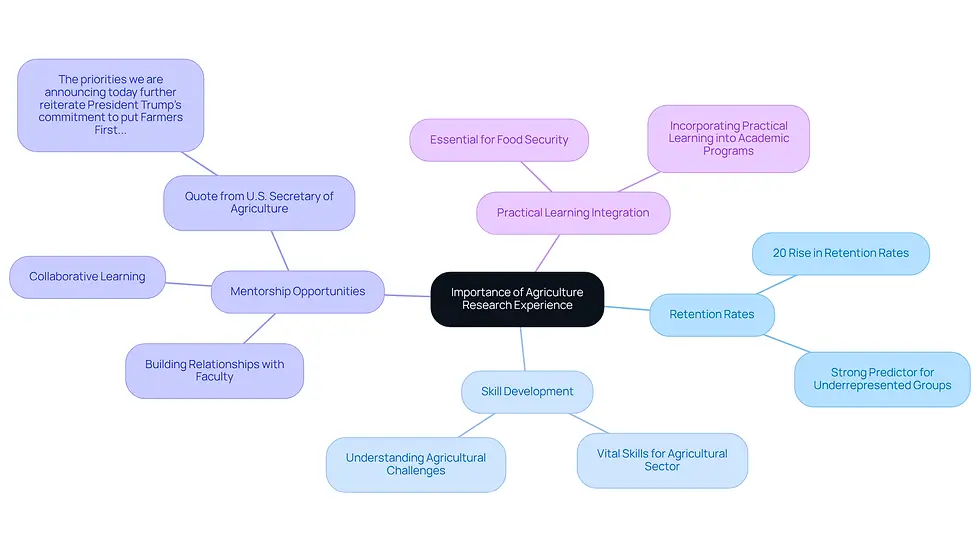
Studies show that undergraduate scholarly activities are a strong predictor of higher retention rates in science-related fields, especially for underrepresented groups. For example, involvement in undergraduate projects can result in a 20% rise in retention rates among these individuals. Such agriculture research experience for college students equips them with vital skills and provides a clearer understanding of the agricultural sector.
Furthermore, getting involved in research helps students build valuable relationships with faculty, promoting mentorship opportunities and collaborative learning that are vital for academic and professional growth. As U.S. Secretary of Agriculture Brooke L. Rollins stated, "The priorities we are announcing today further reiterate President Trump’s commitment to put Farmers First and offers our farming researchers with a strategic roadmap to help keep our producers at the forefront of productivity."
This alignment with USDA's study priorities highlights the significance of incorporating practical learning into academic programs. Integrating practical learning into academic programs is not just beneficial; it is essential for addressing the future of food security and sustainability.
Trace the Origins and Evolution of Agriculture Research Experience
The evolution of farming studies has been pivotal in shaping modern agricultural practices. Studies in farming trace their beginnings to the formation of land-grant universities in the 19th century, which were intended to improve education and studies related to agriculture. The Morrill Act of 1862 provided public lands to states to fund these institutions, aiming to improve farming practices and boost food production through accessible education.
By 1915, farming education had expanded significantly, with 4,665 high schools in the U.S. offering classes to nearly 91,000 students. This reflects the significant growth of farming education. Over time, agricultural study has evolved from traditional farming techniques to include modern scientific methods, such as biotechnology and sustainable practices.
The incorporation of experiential learning models, such as internships and Supervised Agricultural Experiences (SAEs), has significantly enriched the educational landscape and provided valuable agriculture research experience for college students. These opportunities allow students to participate directly in projects, fostering innovation and contributing to advancements in the field.
Despite their expertise, agriculture scholars struggle to effectively convey their research to the public, which presents a challenge in disseminating their findings. This ongoing evolution underscores the critical need for effective communication of agricultural research to tackle global challenges.

Identify Key Characteristics of Agriculture Research Experience
Effective agriculture research experience for college students is essential for bridging the gap between theory and practice in the agricultural sector. Key characteristics of these experiences include:
Hands-on learning
Robust mentorship opportunities
Interdisciplinary collaboration
Real-world application
Successful programs incorporate organized support from faculty, providing learners access to research facilities and opportunities to present their findings. These agriculture research experiences for college students foster critical thinking and problem-solving abilities, enabling learners to tackle real challenges in agriculture. For instance, initiatives that promote teamwork among individuals from various disciplines - such as biology, environmental science, and economics - can yield innovative solutions and a comprehensive understanding of farming challenges.
Guidance plays a vital role in these situations, assisting learners in their academic endeavors and preparing them for future careers by providing agriculture research experience for college students and related fields. Research indicates that effective mentorship significantly enhances learner engagement and success in academic settings, highlighting its importance in providing agriculture research experience for college students. Furthermore, Coltie's Research Portfolio Management improves these experiences by offering updated faculty profiles that display research in real time, complemented by engaging short research videos and team updates. This fosters essential relationships among students, alumni, and partners, further supporting the development of the agricultural sector. Case studies like the GrowSmart Farming mentorship program illustrate how mentorship can cultivate essential skills and knowledge for aspiring farmers, ultimately contributing to the growth of the agricultural sector. Ultimately, the integration of mentorship and agriculture research experience for college students is essential for cultivating the next generation of agricultural leaders.

Conclusion
Agriculture research experience is essential for bridging the gap between theory and practice in the agricultural sector. By engaging in hands-on learning opportunities, students enhance their understanding of real-world farming challenges and develop critical skills essential for their future careers. This hands-on learning is crucial for developing future agricultural leaders who can effectively address challenges in food security and sustainability.
Throughout the article, various forms of agriculture research experiences, such as internships and supervised farming opportunities, have been highlighted as instrumental in fostering students' growth. Programs like the Wallace-Carver Fellowship and the FACTS Bridge Program provide invaluable insights and networking opportunities while also improving employability. Additionally, the historical evolution of agricultural education underscores the importance of integrating practical experiences into academic curricula, ensuring students are well-prepared for the complexities of the industry.
The importance of agriculture research experience is clear and impactful. It enriches students' academic journeys and cultivates a deeper appreciation for the agricultural sciences. As the sector faces unprecedented challenges, investing in agriculture research experiences for college students is essential for fostering innovation and ensuring a sustainable future in agriculture. Engaging in these experiences is not just beneficial; it is a vital step toward developing the skills and knowledge necessary to address the agricultural challenges of tomorrow. Without these experiences, students may struggle to meet the evolving demands of the agricultural industry.
Frequently Asked Questions
What is agriculture research experience for college students?
Agriculture research experience for college students involves hands-on involvement in scientific investigations that address real-world farming challenges through internships, summer study programs, and supervised farming opportunities.
How does agriculture research experience benefit college students?
It allows students to apply classroom knowledge to real-world challenges, enhancing their critical thinking and problem-solving skills, while also improving their employability by providing practical skills and insights into contemporary farming issues.
What are some effective internship initiatives for agriculture research?
Notable programs include the Wallace-Carver Fellowship and the HACU National Internship Program, which offer valuable experiences in agriculture research and policy evaluation.
What opportunities does the Wallace-Carver Fellowship provide?
The Wallace-Carver Fellowship enables students to collaborate with scientists and policymakers, gaining direct knowledge in farming and economic policy analysis.
What is the USDA's investment in agriculture research for 2023?
The USDA invested $262.5 million to support over 60 minority-serving institutions, facilitating new scholarships and internships that promote experiential learning in agriculture.
How does the FACTS Bridge Program contribute to agriculture research experience?
The FACTS Bridge Program involves students in farming science and study, preparing them for careers that address urgent issues like food scarcity and climate change.
What are the advantages of practical farming internships?
Practical farming internships provide direct exposure to the farming industry, leading to improved career planning and a more positive perception of job opportunities in agriculture.
How do hands-on experiences impact students' interests in agriculture?
Engaging in hands-on inquiry helps students acquire vital skills and fosters a greater appreciation for the sciences of farming, ultimately influencing their career interests and aspirations in the sector.
List of Sources
Define Agriculture Research Experience for College Students Research Guides: Agricultural Systems and Education: Agricultural Statistics (https://libguides.lib.siu.edu/c.php?g=778225&p=9231559) Summer Research Experience | Undergraduate Students | College of Agriculture and Natural Resources (https://udel.edu/canr/current-students/current-undergrad/careers-and-internships/summer-research-experience) Internships and Career Opportunities (https://usda.gov/farming-and-ranching/agricultural-education-and-outreach/youth-agriculture/internships-and-career-opportunities) A summer agricultural research program enlarges community college students’ perceptions of agricultural careers | Advancements in Agricultural Development (https://agdevresearch.org/index.php/aad/article/view/315) Students Conduct Ag Tech Research on Campus for USDA Internships (https://uctechnews.ucop.edu/students-conduct-ag-tech-research-on-campus-for-usda-internships)
Contextualize the Importance of Agriculture Research Experience Inspiring Students to Pursue Agricultural Careers (https://news.ncsu.edu/2026/02/inspiring-students-to-pursue-agriculture-careers) LibGuides: Undergraduate Research: Studies on the Impact of Undergraduate Research on Students (https://libguides.usu.edu/c.php?g=1066148&p=7820635) Secretary Rollins Announces New Priorities for Research and Development in 2026 (https://usda.gov/about-usda/news/press-releases/2025/12/30/secretary-rollins-announces-new-priorities-research-and-development-2026) Sustainable Agricultural Productivity Growth: What, Why and How (https://usda.gov/about-usda/general-information/staff-offices/office-chief-economist/sustainability/sustainable-productivity-growth-coalition/sustainable-agricultural-productivity-growth-what-why-and-how)
Trace the Origins and Evolution of Agriculture Research Experience Read (https://nationalacademies.org/read/4980/chapter/2) Agricultural Education | Education | Research Starters | EBSCO Research (https://ebsco.com/research-starters/education/agricultural-education) Supporting the Changing Research Practices of Agriculture Scholars - Ithaka S+R (https://sr.ithaka.org/publications/supporting-the-changing-research-practices-of-agriculture-scholars) The U.S. Land-Grant University System: Overview and Role in Agricultural Research (https://congress.gov/crs-product/R45897) Supporting Global Research and Outreach for Land-Grant Universities Makes Good Sense in Today’s World (https://agnr.umd.edu/news/supporting-global-research-and-outreach-land-grant-universities-makes-good-sense-todays-world)
Identify Key Characteristics of Agriculture Research Experience Mentorship in Agriculture: Our Role (https://cfsph.iastate.edu/thelivestockproject/mentorship-in-agriculture-our-role) Statistics and Agricultural Research (https://ohioline.osu.edu/factsheet/anr-40) Identifying Innovative Agricultural Education Programs | Journal of Career and Technical Education (https://journalcte.org/articles/10.21061/jcte.v27i2.558)



Comments