

8 Steps to Implement Academic Workflow Automation for Research Management

Updated: Jun 3
Introduction
In academic research, excessive administrative tasks can hinder innovation and productivity. Academic workflow automation emerges as a transformative solution, streamlining processes such as data management and communication to free up valuable time for researchers. Yet, implementing effective automation involves navigating various complexities that require careful planning and execution. By implementing automation, institutions can significantly improve their research efficiency and output.
Define Academic Workflow Automation
In the realm of academic research, efficiency is often hindered by repetitive administrative tasks. Academic workflow automation for research opportunity management employs technology to simplify and mechanize tasks related to research management, including data collection, document handling, and stakeholder communication. Introducing automated processes can lead to substantial efficiency gains. Research indicates that organizations employing such systems see up to a 70% decrease in data-related mistakes within the initial year. This enhances process accuracy and enables faculty and students to concentrate on meaningful research activities instead of administrative tasks.
Coltie's Research Portfolio Management streamlines this by offering unified, automatically updated profiles for faculty and labs, showcasing research as it happens. Additionally, short research videos (Bytes) and team updates (Posts) connect students, alumni, and partners, fostering a collaborative academic environment. Moreover, automated processes in course registration confirm prerequisites and course availability in real-time, ensuring a more seamless experience for all parties involved. Organizations implementing process streamlining indicate a 30% rise in student satisfaction, greatly enhancing the overall research experience and promoting a more effective academic environment.
Grasping the basics of academic process automation is essential for institutions striving to identify specific needs and goals. Ultimately, embracing academic workflow automation for research opportunity management can redefine research management and elevate institutional effectiveness.

Assess Your University’s Workflow Needs
To enhance operational efficiency, universities must first assess their current research management processes and identify key areas for improvement. Begin by outlining existing processes, focusing on identifying bottlenecks, redundancies, and manual tasks. Engaging with faculty and administrative personnel is crucial, as their insights reveal experiences and challenges within the operational environment. This collaborative approach helps identify specific processes that would benefit from automation.
For instance, the University of Pécs established an automated system that led to a threefold rise in international student enrollment over five years, demonstrating the potential impact of mechanization. Consider factors such as task volume, process complexity, and the potential for minimizing errors. Organizations that implement process streamlining report a 30% increase in student satisfaction due to easier access to information and services.
Failure to streamline these processes may result in continued operational inefficiencies and decreased satisfaction among students and staff. By thoroughly understanding these needs, you can prioritize which workflows to automate first. By prioritizing automation in critical workflows, universities can significantly improve their operational effectiveness and overall stakeholder satisfaction.

Establish Clear Automation Objectives
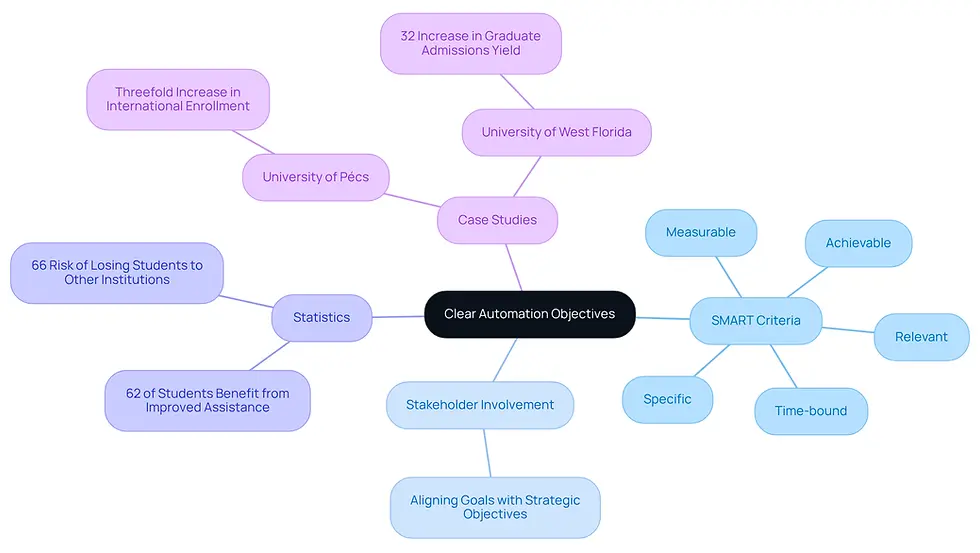
Setting clear goals for mechanization is crucial for achieving desired outcomes in processing times, data precision, and team communication. Using the SMART criteria - Specific, Measurable, Achievable, Relevant, and Time-bound - can greatly improve the clarity and effectiveness of your goals. For instance, instead of a vague goal like 'improve efficiency,' a more precise objective would be 'reduce document processing time by 30% within six months.' This specificity helps clarify expectations and makes it easier to track progress.
Involving key stakeholders in this process is essential to ensure that the objectives are realistic and aligned with the university's strategic goals. A recent survey showed that 62% of students would benefit from improved assistance during admissions, and institutions risk losing 66% of students to other universities while awaiting decisions. This emphasizes the urgency of establishing clear objectives for automated processes.
Additionally, institutions that set clear objectives for technology can enhance operations. For example, the University of Pécs experienced a threefold rise in international student enrollment after introducing an automated application management system. Similarly, the University of West Florida saw a 32% increase in graduate admissions yield due to an AI-driven agent that interacted with prospective students. Establishing clear objectives not only retains students but also enhances overall operational efficiency.
Select the Right Automation Tools
Selecting the right automation solutions is crucial for aligning with institutional strategies and enhancing operational efficiency. Start by investigating available options that match your defined objectives and establish clear goals that represent your institutional strategy. Consider the following factors:
Ease of use
Integration capabilities with existing systems
Scalability
Engaging with vendors for demonstrations and trial periods is crucial for informed decision-making, as it enables real-world evaluation of the resources. Furthermore, collect feedback from faculty and staff who will be utilizing these resources to ensure they fulfill user requirements efficiently. Popular automation applications in academic environments include:
Project management software
Document management systems
Communication platforms
Coltie's SAGE and PreSAGE resources stand out as innovative solutions that automate responses, streamline communication, track engagement, and measure research visibility. These tools enable immediate visibility and measurable recruitment gains. Coltie helps institutions transform their academic processes by enhancing faculty-student relationships and providing clear, student-focused recruitment experiences. Ultimately, the right choices can transform academic processes and foster a more engaging learning environment, ensuring that chosen tools facilitate seamless academic operations while alleviating administrative pressures and empowering staff to concentrate on meaningful student engagement.

Design Customized Workflows
To create efficient personalized procedures, it is crucial to outline the specific steps involved in each process slated for automation. Involving stakeholders early in the process is essential to identify critical tasks and decision points, fostering a collaborative atmosphere that enhances the process's relevance and effectiveness. According to Kissflow Automation Trends, 94% of organizations engage in repetitive tasks that automation could eliminate, underscoring the importance of stakeholder collaboration in process design.
Use flowcharts or process diagrams to visualize the processes, aiding clarity and enhancing understanding among participants.
Integrate feedback loops and checkpoints within the process to allow for necessary adjustments, ensuring adaptability to changing needs.
Consider how the automated procedure will integrate with existing systems and processes to guarantee a seamless transition.
Research indicates that process management can reduce repetitive tasks by 60-90%, and 78% of organizations realize a return on investment (ROI) within six months of implementation. By customizing workflows to meet your institution's unique needs, you can significantly boost efficiency and enhance the overall management through academic workflow automation for research opportunity management.

Integrate Automation Tools with Existing Systems
A thorough evaluation of your institution's technology environment is essential for successful integration of automated solutions. In 2024, nearly two-thirds of educational institutions experienced cyberattacks, highlighting the critical need for secure integration.
Identify compatibility issues that can create significant barriers to effective integration and plan for necessary upgrades or modifications.
Collaborate closely with IT departments to ensure seamless integration, allowing for smooth data flow between systems.
According to Aastha Arya, trustworthy software solutions need to comply with strict data protection regulations, including GDPR and FERPA, to safeguard sensitive information.
Conduct comprehensive testing to uncover potential issues before full-scale implementation.
Additionally, provide clear documentation and training for individuals to facilitate a smooth transition.
For instance, Idaho State University completed IRB and IACUC reviews up to 200% faster with Cayuse, showcasing the benefits of effective integration. Ultimately, implementing academic workflow automation for research opportunity management in alignment with existing systems is crucial for maximizing research management efficiency.

Train and Support Users
Initiating training on new automation tools before their implementation is essential for successful adoption. A thorough training program is crucial and should include:
Hands-on workshops
Online tutorials
Detailed guides
Customizing the training for different groups - faculty, staff, and students - ensures that each group receives relevant information. This tailored approach enhances engagement and effectiveness. Continuous assistance is essential; setting up help desks, community forums, and regular check-ins can effectively address questions and concerns. Gathering feedback from individuals is vital for the ongoing enhancement of the training process.
When institutions invest in user education and support, they not only boost proficiency with new systems but also create a culture of acceptance, ultimately resulting in higher adoption rates. For example, at Muhlenberg College, the introduction of automated systems led to a 50% rise in attendance and saved personnel 12 hours weekly, showcasing the concrete advantages of efficient training and assistance. Furthermore, a survey indicated that 54.58% of respondents anticipate AI's impact on their job security, underscoring the necessity for universities to proactively address these concerns through robust training initiatives. By framing new tools as assets rather than burdens, institutions can foster a supportive environment that empowers faculty and staff to embrace technology confidently. Additionally, the potential cost reductions from mechanization can lead to considerable financial advantages for institutions, enabling reinvestment in student programs and resources. Ultimately, a well-structured training program can transform apprehension into enthusiasm, paving the way for a more innovative educational environment.

Troubleshoot Common Implementation Challenges
Implementing academic workflow streamlining can present significant challenges that require careful navigation. Here are several strategies to navigate these challenges effectively:
Foster Open Communication: Engage stakeholders early in the process to address concerns and gather feedback. Transparency about the benefits and changes associated with automation can alleviate fears and build trust. As Adlon Pereira states, "The solution lies in transparency and clear communication."
Establish a Dedicated Support Team: Assign a team to assist individuals during the transition. This team can provide training, answer questions, and offer ongoing support, which is essential for adoption.
Monitor Performance Regularly: Continuously assess the performance of automation tools. Be prepared to make adjustments based on feedback and system performance to ensure optimal functionality.
Create a Feedback Loop: Implement mechanisms for individuals to report ongoing issues. Regularly reviewing this feedback allows for timely interventions and improvements.
Address Technical Issues Proactively: Common technical challenges include software incompatibility and data migration errors. Utilizing middleware solutions can facilitate smoother integration with legacy systems, reducing downtime and enhancing user experience.
Pilot Programs: Start with a small-scale pilot in one department to identify issues and gather insights before a full rollout. This approach allows for adjustments based on real-world feedback.
Training and Change Management: Comprehensive training programs can ease the transition. Training employees on the advantages of mechanization and how to utilize new systems effectively nurtures a positive atmosphere for transformation.
Celebrate Small Wins: Acknowledging and celebrating milestones throughout the implementation process can strengthen the advantages of mechanization and encourage personnel to accept the changes.
By addressing these challenges, institutions can significantly enhance their operational efficiency and user experience. The expected yearly increase in productivity resulting from mechanization is between 0.8% and 1.4%, highlighting the potential advantages of these initiatives. Additionally, it is essential to consider data security and compliance challenges, as these are significant concerns in automation implementation.

Conclusion
Embracing academic workflow automation is essential for fostering a more efficient academic environment. Streamlining repetitive tasks and enhancing communication allows institutions to reduce errors significantly, enabling faculty and students to concentrate on meaningful research.
Throughout the article, key steps for implementing this automation have been outlined, including:
Assessing current workflow needs
Establishing clear objectives
Selecting appropriate tools
Designing customized workflows
Ensuring robust user training and support
Each of these components plays a crucial role in creating a seamless transition to automated processes, ultimately leading to increased operational efficiency and improved stakeholder satisfaction.
As institutions navigate the complexities of integrating automation into their research management practices, it is imperative to recognize the potential benefits that lie ahead. Integrating automation into research management practices can be challenging for institutions. However, this proactive approach not only enhances the academic experience but also positions universities to adapt to future challenges. When institutions prioritize automation, they create a culture of innovation that keeps them ahead, ensuring they remain at the forefront of academic excellence in a rapidly changing landscape.
Frequently Asked Questions
What is academic workflow automation?
Academic workflow automation refers to the use of technology to simplify and mechanize tasks related to research management, such as data collection, document handling, and stakeholder communication, thereby improving efficiency and reducing administrative burdens.
How does academic workflow automation benefit research management?
It can lead to substantial efficiency gains, including a reported 70% decrease in data-related mistakes within the first year of implementation, allowing faculty and students to focus on meaningful research activities.
What is Coltie's Research Portfolio Management?
Coltie's Research Portfolio Management streamlines research management by providing unified, automatically updated profiles for faculty and labs, along with short research videos and team updates to foster collaboration among students, alumni, and partners.
How does automation impact course registration processes?
Automated processes in course registration confirm prerequisites and course availability in real-time, ensuring a more seamless experience for students and faculty.
What are the effects of implementing academic workflow automation on student satisfaction?
Organizations that implement process streamlining report a 30% increase in student satisfaction, enhancing the overall research experience and promoting a more effective academic environment.
How should universities assess their workflow needs for automation?
Universities should begin by outlining existing research management processes, identifying bottlenecks, redundancies, and manual tasks, and engaging with faculty and administrative personnel to gather insights on challenges and experiences.
Can you provide an example of successful workflow automation in a university?
The University of Pécs established an automated system that resulted in a threefold increase in international student enrollment over five years, demonstrating the significant impact of automation.
What factors should universities consider when prioritizing workflows for automation?
Universities should consider task volume, process complexity, and the potential for minimizing errors when determining which workflows to automate first to improve operational effectiveness and stakeholder satisfaction.
List of Sources
Define Academic Workflow Automation Automation in Higher Education: Strategic Workflow Solutions Driving Institutional Growth (https://goedmo.com/blog/automation-in-higher-education) How to Simplify Processes in Education with Workflow Automation Solutions | ActiveBatch by Redwood (https://advsyscon.com/blog/education-workflow-automation) Education workflow automation: What it is and why you need it for your institution (https://redwood.com/article/education-workflow-automation) Workflow Automation Solutions for Education | Yorosis Blogs (https://yorosis.com/how-workflow-automation-solutions-reshaping-education) Realizing Opportunities for Advanced and Automated Workflows in Scientific Research (https://nationalacademies.org/our-work/realizing-opportunities-for-advanced-and-automated-workflows-in-scientific-research)
Assess Your University’s Workflow Needs The Future of Higher Ed & How Workflow Software Supports It (https://kuali.co/post/the-future-of-higher-education-and-how-workflow-software-can-help) Education workflow automation: What it is and why you need it for your institution (https://redwood.com/article/education-workflow-automation) Automation in Higher Education: Strategic Workflow Solutions Driving Institutional Growth (https://goedmo.com/blog/automation-in-higher-education) How Colleges Can Use Workflow Automation to Cut Costs (https://gravityflow.io/articles/how-colleges-can-use-workflow-automation-to-cut-costs) Workflow for Higher Education: Implementation Guide (2026) (https://engineerica.com/academic-centers/post/workflow-for-higher-education)
Establish Clear Automation Objectives A guide to making automation work in higher education (https://timeshighereducation.com/campus/guide-making-automation-work-higher-education) Automation in Higher Education: Strategic Workflow Solutions Driving Institutional Growth (https://goedmo.com/blog/automation-in-higher-education) Being smart about writing SMART objectives (https://sciencedirect.com/science/article/abs/pii/S0149718916302580) Setting Clear Automation Goals: Enhancing Workflow & Functionality (https://redwood.com/article/setting-automation-goals-enhancing-workflow-functionality) What Is SMART in Project Management? (https://wrike.com/project-management-guide/faq/what-is-smart-in-project-management)
Select the Right Automation Tools A guide to making automation work in higher education (https://timeshighereducation.com/campus/guide-making-automation-work-higher-education) Automation in Higher Education (https://processmaker.com/blog/automation-in-higher-education) Research Automation Tools Compared 2026: Streamlining Academic Work (https://citedevidence.com/help/research-automation-tools-compared-2026-streamlining-academic-work) Revolutionizing University Operations: | MAU (https://maufl.edu/how-automation-transforms-marketing-admissions) Automation Today: Publication & Newsletter: How Universities can use software automation to increase quality assurance, improve student experiences, and provide better use of resources (https://automationtoday.net/featuredarticles/how-universities-can-use-software-automation-to-increase-quality-assurance-improve-student-experiences-and-provide-better-use-of-resources)
Design Customized Workflows Understanding the Influence and Impact of Stakeholder Engagement in Patient-centered Outcomes Research: a Qualitative Study - PMC (https://pmc.ncbi.nlm.nih.gov/articles/PMC8993962) Realizing Opportunities for Advanced and Automated Workflows in Scientific Research (https://nationalacademies.org/our-work/realizing-opportunities-for-advanced-and-automated-workflows-in-scientific-research) 26 Workflow Optimization Stats for 2025 (https://anchorgroup.tech/blog/custom-workflow-optimization-statistics) New Clarivate Study Examines the Impact of Academic AI on Core Library Workflows (https://clarivate.com/news/new-clarivate-study-examines-the-impact-of-academic-ai-on-core-library-workflows) Unleash this Awesome AI-Powered Research Workflow for Efficient Research (https://medium.com/@susantamit/unleash-this-awesome-ai-powered-research-workflow-for-efficient-research-b4bf49d10315)
Integrate Automation Tools with Existing Systems Automation in Higher Education: Strategic Workflow Solutions Driving Institutional Growth (https://goedmo.com/blog/automation-in-higher-education) How Intelligent Automation Is Driving Research (https://cayuse.com/blog/how-intelligent-automation-is-driving-research) How Businesses Are Using Automation & AI in Management – St. Thomas University (https://stu.edu/news/how-businesses-use-ai-and-automation-to-improve-management-efficiency) ABACC Empowers Christian Business Officers in Higher Ed (https://myabacc.org/blog/automation-ai-are-fast-becoming-critical-in-higher-education) A guide to making automation work in higher education (https://timeshighereducation.com/campus/guide-making-automation-work-higher-education)
Train and Support Users Overcoming Technology in Higher Education Bias - raftr (https://raftr.com/overcoming-resistance-to-technology-in-higher-education) Automation in schools: Benefits, tools & implementation tips (https://koalendar.com/blog/automation-in-schools) Top School Workflow Automation Tools for 2025 - DreamClass (https://dreamclass.io/2025/how-can-schools-streamline-operations-using-workflow-automation-tools) User Adoption of New Technology: Strategies to Increase Engagement | Educe (https://educegroup.com/blog/user-adoption-of-new-technology-strategies-to-increase-engagement) Automation in Higher Education (https://processmaker.com/blog/automation-in-higher-education)
Troubleshoot Common Implementation Challenges Common challenges in implementing workflow automation and how to avoid them? (https://tinycommand.com/blogs/common-challenges-in-implementing-workflow-automation-and-how-to-avoid-them) Common Challenges and Solutions While Implementing a Campus Automation System (And How to Fix Them) (https://spacebasic.com/blogs/campus-automation-system-challenges-and-how-solve-them) Workflow for Higher Education: Implementation Guide (2026) (https://engineerica.com/academic-centers/post/workflow-for-higher-education) Common Challenges When Setting Up Automated Workflows and How to Overcome Them (https://eskuad.com/blog/common-challenges-when-setting-up-automated-workflows-and-how-to-overcome-them) Overcoming Resistance to Change in Higher Ed Webinar (https://changinghighered.com/overcoming-resistance-to-change-in-higher-ed)



Comments