

Maximize Research Opportunity Matching Using LLMs for Universities

Updated: Sep 1
Introduction
Many universities are grappling with outdated research opportunity matching processes that fail to address the evolving needs of students and faculty. Large Language Models (LLMs) represent a significant advancement in AI, capable of transforming these matching processes by analyzing complex datasets and generating valuable insights. Institutions must explore how to effectively harness the potential of LLMs to enhance efficiency and personalization while overcoming integration challenges. This article outlines best practices for maximizing research opportunity matching through LLMs, highlighting strategies that can enhance academic engagement and collaboration.
Understand LLMs in Research Opportunity Matching
Current matching processes in academia often struggle to meet the evolving needs of students and faculty. Large Language Models (LLMs) are advanced AI systems that can understand and generate human-like text by processing vast amounts of data. In the context of opportunity alignment, LLMs facilitate research opportunity matching using LLMs by assessing and comprehending intricate datasets, recognizing trends, and producing insights that enable improved connections between students and faculty project opportunities.
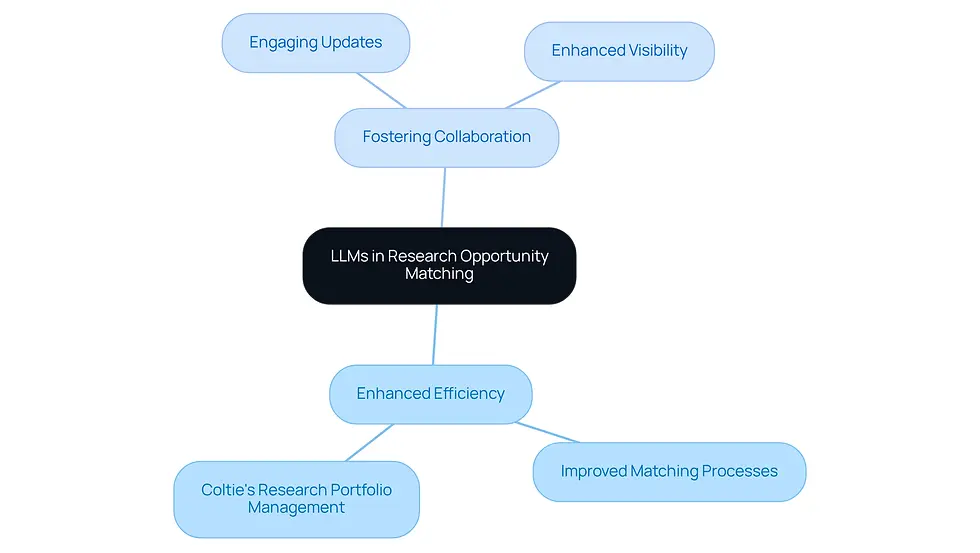
Enhanced Efficiency: LLMs improve matching processes, making them more intuitive and responsive to what users need. Coltie's Research Portfolio Management complements this by offering unified, auto-updated faculty and lab profiles that display findings in real time.
Fostering Collaboration: Engaging updates on studies, including short videos and team posts, connect students, alumni, and partners. This approach enhances visibility and fosters academic collaboration.
Understanding the role of large language models in research opportunity matching using LLMs can redefine how universities approach academic collaboration.
Implement Effective Strategies for LLM Integration
To improve matching processes, universities should adopt the following strategies:
Assess Institutional Needs: Conduct a comprehensive analysis to identify inefficiencies and areas for enhancement in existing matching processes. This assessment should incorporate feedback from both learners and faculty, ensuring that the integration effectively addresses their needs. Coltie's platform effectively connects learners with faculty, ensuring their perspectives are integral to the recruitment process.
Choose the Right LLM: Select an LLM that meets the institution's specific requirements. Key considerations include the model's training data, its proficiency in handling domain-specific language, and its effectiveness in generating relevant outputs. Institutions should also consider current trends in LLM selection criteria, ensuring that the chosen model supports flexible pathways for student success. Coltie's intelligent pairing system can enhance this selection process by providing insights into the most effective LLMs for specific academic needs.
Develop Clear Use Cases: Establish specific use cases for LLM applications in study matching. Possible uses may include automating the initial evaluation of project proposals, generating tailored suggestions for learners, or summarizing faculty interests. By aligning these use cases with workforce needs, universities can enhance the relevance of their programs. Coltie's engaging video profiles can also contribute here, showcasing faculty research interests in a way that connects with potential learners.
Pilot Programs: Launch pilot initiatives to assess the incorporation of large language models in a controlled environment. Collect data on performance and user satisfaction to refine the approach prior to full-scale implementation. Successful institutions demonstrate the importance of evaluating new technologies in real-world settings. Coltie can assist these pilot programs by offering a platform for faculty and learners to connect and share feedback.
Training and Support: Offer training for faculty and staff on the effective use of LLMs within their workflows. Continuous support is crucial to address any challenges that may arise during the integration process. Institutions must ensure that the incorporation of technology is carried out responsibly, as emphasized by Dr. Donna Hodge, who highlights the significance of equipping learners for meaningful contributions. Coltie's resources can assist in this training, ensuring that faculty are equipped to engage with students effectively.
If these issues remain unaddressed, universities may find it increasingly difficult to attract and retain talent. By strategically implementing these approaches, universities can enhance their processes for research opportunity matching using LLMs and support their mission to cultivate critical thinkers and engaged citizens through Coltie's innovative platform.

Leverage Benefits of LLMs for Enhanced Matching Outcomes
The integration of LLMs into research opportunity matching using llms presents a transformative approach to enhancing academic collaboration.
Enhanced Productivity: Large language models can handle vast amounts of data rapidly, markedly decreasing the time needed to pair individuals with appropriate opportunities for inquiry. This efficiency enables faculty to prioritize mentoring over administrative duties.
Enhanced Personalization: Large language models enhance personalization by analyzing learner profiles and preferences to provide tailored suggestions that align with academic goals. This fosters more significant faculty-learner connections.
Enhanced Precision: The precision of large language models stems from their sophisticated algorithms, which identify relevant connections based on nuanced criteria. This results in greater accuracy in aligning learners with faculty research initiatives, reducing mismatches and enhancing overall satisfaction.
Scalability: Scalability is a key advantage of large language models, as they can manage increasing datasets without adding to administrative burdens. This ensures that alignment processes remain efficient as universities expand and the number of students and faculty rises.
Data-Driven Insights: Data-driven insights generated by large language models enable institutions to refine recruitment strategies and improve future alignment outcomes. By leveraging historical alignment data, institutions can make informed decisions based on empirical evidence.
Ultimately, research opportunity matching using llms not only streamlines the matching process but also cultivates a more engaged and satisfied academic community.

Examine Case Studies of Successful LLM Implementations
Traditional matching processes in academia often fall short, leading to inefficiencies that can stifle research opportunities. Several universities have successfully integrated large language models (LLMs) into their research opportunity matching processes, yielding positive results:
Stanford University: Stanford's Technology Transfer for Defense program utilized LLMs to match defense funding with academic initiatives. By automating the pairing process, they enhanced the speed and precision of funding distributions, leading to more successful partnerships between researchers and funding organizations.
Carnegie Mellon University: CMU implemented an LLM-based system to enhance student-faculty matching for scholarly opportunities. The system examined profiles of learners and faculty research interests, resulting in a 30% rise in successful matches compared to conventional methods.
Peking University: This institution implemented large language models to enhance the recruitment process for graduate candidates. By utilizing LLMs to analyze applicant data and pair them with faculty advisors, they improved the overall student experience and boosted enrollment rates in competitive programs.
These case studies illustrate how research opportunity matching using LLMs can be streamlined. As universities explore the integration of LLMs, they may find that these technologies not only enhance efficiency but also redefine the landscape of academic collaboration.

Conclusion
The integration of Large Language Models (LLMs) into research opportunity matching signifies a major shift in how universities approach academic collaboration. By leveraging LLM capabilities, institutions can address inefficiencies in current matching processes, creating better connections between students and faculty and improving operational efficiency.
Key insights from the article emphasize the importance of understanding LLMs, implementing effective integration strategies, and leveraging their benefits to enhance matching outcomes. Strategies such as:
Assessing institutional needs
Selecting the appropriate LLM
Launching pilot programs
are crucial for successful implementation. Additionally, real-world case studies from institutions like Stanford and Carnegie Mellon illustrate the tangible improvements that LLMs can facilitate in academic settings.
By embracing LLMs, universities improve the efficiency of research opportunity matching and create a more engaged academic community. As institutions continue to explore these transformative technologies, the potential for enhanced collaboration and talent retention becomes increasingly significant. By proactively integrating LLMs, institutions can redefine academic collaboration, ensuring a more dynamic and responsive educational environment.
Frequently Asked Questions
What are Large Language Models (LLMs) and their role in research opportunity matching?
LLMs are advanced AI systems that can understand and generate human-like text by processing vast amounts of data. In research opportunity matching, they assess complex datasets, recognize trends, and generate insights to improve connections between students and faculty project opportunities.
How do LLMs enhance the efficiency of matching processes in academia?
LLMs make matching processes more intuitive and responsive to user needs, improving overall efficiency in aligning research opportunities.
What is Coltie's Research Portfolio Management?
Coltie's Research Portfolio Management is a system that complements LLMs by providing unified, auto-updated faculty and lab profiles, displaying findings in real time.
How do LLMs foster collaboration in academic settings?
LLMs facilitate collaboration by providing engaging updates on studies, including short videos and team posts, which connect students, alumni, and partners, enhancing visibility and academic collaboration.
What impact can understanding LLMs have on academic collaboration?
Understanding the role of LLMs in research opportunity matching can redefine how universities approach academic collaboration, potentially leading to more effective partnerships and project alignments.
List of Sources
Understand LLMs in Research Opportunity Matching apa.org (https://apa.org/topics/artificial-intelligence-machine-learning/ai-research-writing)
Implement Effective Strategies for LLM Integration Unifying Campus Technology Solutions to Power Higher Ed | Ellucian (https://ellucian.com/blog/dont-be-next-blockbuster-higher-ed-relevance)



Comments