

4 Best Practices for Using AI Tools to Find Research Opportunities

Updated: May 28
Introduction
Researchers often struggle to identify key studies amidst the vast amount of literature available, which can hinder their ability to uncover valuable research opportunities. By harnessing the power of AI tools, researchers can enhance their productivity and identify critical gaps in their fields. However, as these technologies become integral to research workflows, this raises an important question: how can scholars navigate the complexities of AI adoption effectively?
Understand the Role of AI in Research Opportunity Discovery
Scholars often struggle to keep up with the overwhelming volume of academic literature, making it difficult to identify relevant study opportunities. AI tools for finding research opportunities are transforming this landscape by employing machine learning algorithms and natural language processing to examine extensive academic literature, identify emerging trends, and suggest pertinent study topics.
Platforms such as Semantic Scholar and Research Rabbit utilize AI tools for finding research opportunities, enhancing literature searches and allowing scholars to swiftly discover relevant studies and identify gaps in current work.
This capability not only saves valuable time but also improves the quality of studies by keeping scholars informed about the latest advancements in their fields.
Coltie's Research Portfolio Management feature further streamlines this process by providing unified, auto-updated faculty and lab profiles that highlight findings in real time.
This feature automates communication through short informational videos (Bytes) and team updates (Posts), effectively connecting students, alumni, and partners, and fostering a collaborative academic environment.
As AI progresses, understanding and leveraging its capabilities will be crucial for scholars aiming to enhance their academic productivity and foster collaboration in their fields.

Implement Effective Strategies for AI Tool Utilization
Navigating the vast array of AI tools for finding research opportunities can be daunting for researchers, yet adopting key strategies can significantly enhance their effectiveness.
Define Clear Objectives: Before utilizing AI resources, researchers should establish specific goals for what they want to achieve. This could include identifying gaps in literature, generating new research questions, or streamlining data analysis.
Choose the Right Instruments: Not all AI resources are created equal. Researchers should choose AI tools for finding research opportunities that align with their specific needs. For instance, resources such as Elicit can aid in literature reviews, while others like ChatGPT can support in drafting and editing.
Iterate and Experiment: AI resources often require a learning curve. Scientists should be receptive to trying various instruments and techniques, refining their methods according to what is most effective for their study goals.
Stay Informed: The field of AI is rapidly evolving. Researchers should stay informed about the latest advancements and best practices in AI to ensure they are utilizing the most effective resources available.
Implementing these strategies not only enhances productivity but also elevates the quality of research outputs, ultimately advancing the field.

Leverage Benefits of AI Tools for Enhanced Research Outcomes
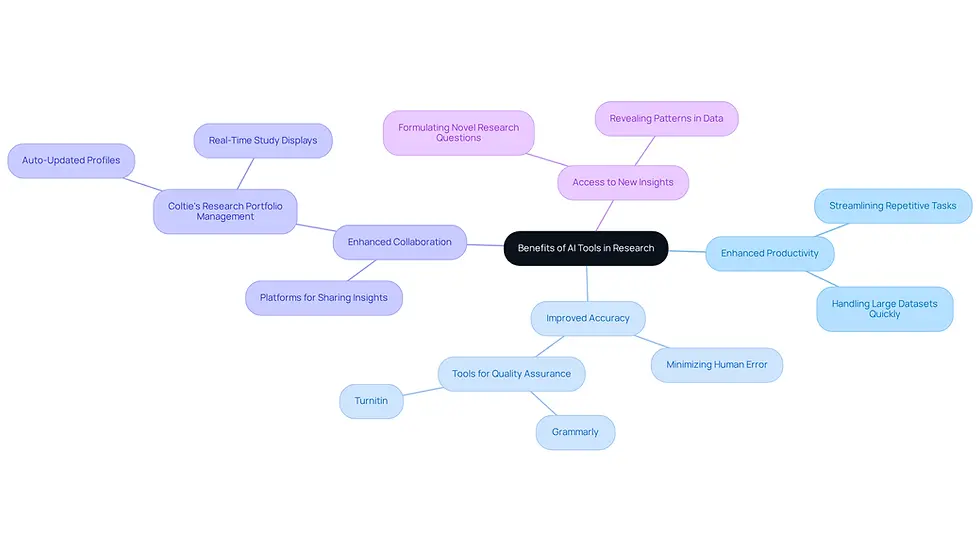
AI tools present significant advantages that can transform research outcomes in higher education:
Enhanced Productivity: AI streamlines repetitive tasks, such as information gathering and examination, enabling scholars to concentrate on more complex aspects of their work. For instance, AI-driven analytical tools can handle large datasets in a fraction of the time needed by human investigators, enhancing the investigation process.
Improved Accuracy: AI algorithms minimize human error in data analysis and literature reviews, resulting in more reliable outcomes. Tools such as Grammarly and Turnitin ensure that written content is free of grammatical mistakes and plagiarism, respectively, thus improving the overall quality of academic outputs.
Enhanced Collaboration: AI tools foster better collaboration among researchers by providing platforms for sharing insights and findings. Coltie's Research Portfolio Management includes unified, auto-updated faculty and lab profiles that display studies in real time, along with short videos and team updates that link students, alumni, and partners. This fosters an engaging atmosphere for collaboration and enhances the visibility of studies.
Access to New Insights: AI can reveal patterns and correlations in data that may not be readily apparent to human analysts. This capability can lead to the formulation of novel research questions and innovative solutions to existing challenges.
Ultimately, leveraging AI tools for finding research opportunities enhances individual research efforts and propels the entire academic community forward.
Overcome Challenges in Adopting AI Tools for Research
While AI tools present numerous advantages, their adoption poses several challenges for researchers:
Information Privacy Concerns: Researchers must ensure adherence to protection regulations when using AI tools. This includes understanding how information is stored and processed by AI platforms. Establishing strong information management practices can alleviate these concerns.
Resistance to Change: Researchers may struggle with the transition to AI tools due to unfamiliarity and fear of becoming obsolete. Providing training and support can ease this transition and foster a culture of innovation within academic institutions.
Algorithm Bias: AI systems can inadvertently perpetuate biases present in their training data. Scholars should critically assess AI outputs and remain vigilant regarding potential biases in their findings. Regular audits of AI systems can help identify and address these issues.
Integration with Current Processes: Incorporating AI instruments into established workflows can be challenging. Researchers should adopt a phased approach to implementation, beginning with pilot projects to evaluate the effectiveness of AI resources before full-scale adoption.
Addressing these challenges is crucial for researchers aiming to leverage AI tools effectively and improve their research outcomes.

Conclusion
AI tools are not merely enhancing research; they are fundamentally reshaping the landscape of academic inquiry. These tools are revolutionizing the way researchers discover opportunities in their fields, offering innovative solutions to the challenges posed by the vast amount of academic literature. By harnessing the power of machine learning and natural language processing, scholars can efficiently identify relevant studies, emerging trends, and gaps in existing research. This shift not only saves researchers valuable time but also significantly boosts the quality and impact of their work.
Throughout the article, key strategies for effectively utilizing AI tools have been highlighted:
Defining clear objectives
Selecting the right tools
Embracing an iterative approach
Staying informed about advancements in AI
These steps are essential for researchers. The benefits of these tools - including improved productivity, accuracy, collaboration, and access to new insights - underscore their potential to elevate research outcomes and foster a more dynamic academic environment.
However, many researchers face significant hurdles in integrating AI tools into their workflows. Challenges such as information privacy, resistance to change, algorithm bias, and integration issues must be addressed. By overcoming these challenges, researchers can significantly enhance their research capabilities and contribute to the advancement of their fields. Ultimately, by embracing AI, researchers can not only improve their own work but also drive the evolution of academic research as a whole.
Frequently Asked Questions
What challenges do scholars face in discovering research opportunities?
Scholars often struggle to keep up with the overwhelming volume of academic literature, making it difficult to identify relevant study opportunities.
How are AI tools changing the way research opportunities are found?
AI tools are transforming the discovery of research opportunities by using machine learning algorithms and natural language processing to examine extensive academic literature, identify emerging trends, and suggest pertinent study topics.
What platforms utilize AI tools for finding research opportunities?
Platforms such as Semantic Scholar and Research Rabbit utilize AI tools to enhance literature searches, allowing scholars to swiftly discover relevant studies and identify gaps in current work.
What benefits do AI tools provide to scholars?
AI tools save valuable time and improve the quality of studies by keeping scholars informed about the latest advancements in their fields.
What is Coltie's Research Portfolio Management feature?
Coltie's Research Portfolio Management feature provides unified, auto-updated faculty and lab profiles that highlight findings in real time, streamlining the research opportunity discovery process.
How does Coltie's feature enhance communication and collaboration?
It automates communication through short informational videos (Bytes) and team updates (Posts), effectively connecting students, alumni, and partners, and fostering a collaborative academic environment.
Why is it important for scholars to understand AI capabilities?
As AI progresses, understanding and leveraging its capabilities will be crucial for scholars aiming to enhance their academic productivity and foster collaboration in their fields.
List of Sources
Understand the Role of AI in Research Opportunity Discovery AI Quotes From Some Of The Worlds Top Minds | Alldus (https://alldus.com/blog/ai-quotes-from-some-of-the-worlds-top-minds) forbes.com (https://forbes.com/sites/shephyken/2026/03/01/twelve-quotes-about-ai-and-how-it-makes-us-better)
Implement Effective Strategies for AI Tool Utilization 70 Research Quotes to Inspire Your Work - Qualtrics (https://qualtrics.com/articles/strategy-research/research-quotes) The promise and perils of using AI for research and writing (https://apa.org/topics/artificial-intelligence-machine-learning/ai-research-writing) Effective and Responsible Use of AI in Research (https://grad.uw.edu/advice/effective-and-responsible-use-of-ai-in-research)
Leverage Benefits of AI Tools for Enhanced Research Outcomes 22 Top AI Statistics And Trends (https://forbes.com/advisor/business/ai-statistics) forbes.com (https://forbes.com/sites/shephyken/2026/03/01/twelve-quotes-about-ai-and-how-it-makes-us-better) The 2025 AI Index Report | Stanford HAI (https://hai.stanford.edu/ai-index/2025-ai-index-report) AI Quotes From Some Of The Worlds Top Minds | Alldus (https://alldus.com/blog/ai-quotes-from-some-of-the-worlds-top-minds)



Comments