

Enhance Career Exploration Through Undergraduate Research: 4 Best Practices

Updated: Jun 30
Introduction
Many students struggle to identify their career aspirations, which can hinder their transition from academic achievement to professional success. Engaging in undergraduate research deepens students' understanding of academic subjects and opens doors to various career paths, thereby enhancing their employability and confidence. Institutions must explore effective strategies to bridge this gap and empower students to navigate their futures through research.
Understand the Importance of Career Exploration in Undergraduate Research
Career exploration serves as a crucial bridge between academic learning and professional development, yet many students struggle to make this connection. By engaging in hands-on investigations, students can apply their theoretical knowledge in real-world settings. This practice fosters critical thinking and problem-solving skills essential for success in the workforce.
Research from the Council on Undergraduate Research shows that hands-on inquiry not only enhances students' understanding of their fields but also prepares them to tackle the challenges they will face in their careers. Students gain insights into various professional paths through career exploration through undergraduate research, helping them identify their interests and strengths. This process not only boosts their confidence and clarifies their professional goals but also significantly enhances their employability and readiness for the job market.

Implement Strategies for Integrating Career Exploration into Research Programs
To enhance the professional readiness of undergraduate students, institutions must implement strategic frameworks that connect academic projects with essential job skills. For instance, 83.3% of colleges are adopting job readiness skills this academic year, indicating a 9% rise from the prior year and showcasing an increasing dedication to integrating professional preparation throughout the educational journey.
By integrating professional preparedness workshops with career exploration through undergraduate research, students gain valuable resources to effectively communicate their experiences in job applications and interviews. Experts in employment services have shown that these workshops significantly boost students' ability to communicate their skills, with 79% of institutions using appointments to aid in this process, and 70% offering workshops to assist individuals in expressing their competencies effectively.
Establishing collaborations with industry experts can also offer learners valuable perspectives on the practical uses of their studies, thus deepening their comprehension of possible professional avenues. Moreover, institutions should motivate faculty to guide learners not only in methodologies but also in professional planning. This comprehensive method to learner development is supported by results showing that 61.4% of graduates who engage in career exploration through undergraduate research believe their college journey equips them effectively for their post-graduation work, in contrast to 41.3% of those who do not participate in research.
By prioritizing professional preparedness throughout the educational experience, institutions can significantly enhance students' readiness for the workforce.

Foster Faculty-Student Collaborations to Enhance Career Exploration
Many students struggle to navigate their professional paths without strong faculty support, making robust faculty-student partnerships essential for success in undergraduate studies. Faculty members play a crucial role in guiding learners through their investigative experiences, offering mentorship that can significantly influence their career exploration through undergraduate research.
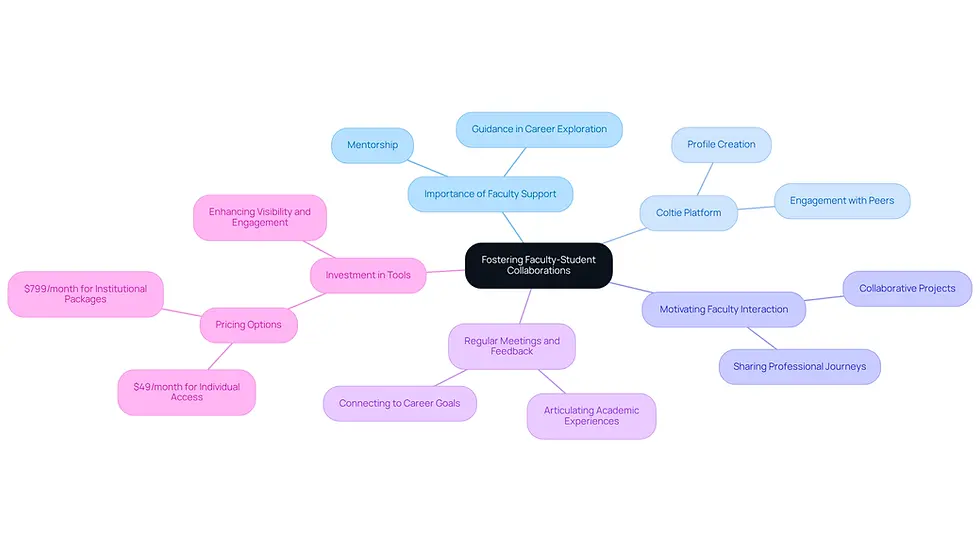
Coltie's platform helps students access information more easily and connect with faculty and peers in their academic community. This innovative tool allows learners to create profiles and engage meaningfully within the academic ecosystem.
Institutions should motivate faculty to interact with students in significant ways, such as through collaborative projects. These initiatives enable individuals to contribute to ongoing inquiries while gaining insights into the academic and professional landscape.
Regular meetings and feedback sessions help students articulate their academic experiences and connect them to their career goals, particularly through career exploration through undergraduate research. Furthermore, providing opportunities for faculty to share their own professional journeys can inspire students and offer valuable networking prospects. Coltie's tools enhance visibility and engagement, making these connections more accessible.
With pricing options ranging from $49/month for individual access to $799/month for comprehensive institutional packages, Coltie offers accessible solutions for enhancing faculty-student interactions. Ultimately, investing in platforms like Coltie can transform the academic experience by promoting career exploration through undergraduate research, equipping students with the tools they need to thrive in their careers.
Leverage Technology to Enhance Career Exploration and Research Connections
Many students find it challenging to navigate their career paths without guidance from industry professionals. Integrating technology into undergraduate study programs can greatly improve professional exploration and networking. Virtual networking platforms, such as webinars and online forums, effectively link learners with industry professionals and alumni, providing valuable insights into different professional paths.
Networking Opportunities: Virtual platforms connect students with industry experts. Webinars and forums offer real-time interaction and advice.
Furthermore, using digital tools for professional evaluations and interest inventories allows individuals to recognize their strengths and connect them with pertinent opportunities for exploration.
Self-Assessment Tools: Digital evaluations help identify personal strengths. Interest inventories guide students toward suitable career paths.
Institutions can also implement online portfolios, enabling learners to display their projects and present their work to potential employers more effectively.
Showcasing Work: Online portfolios provide a platform for students to showcase their skills. This enhances visibility to potential employers.
By embracing technology, institutions can create a more engaging research environment that not only fosters academic growth but also prepares students for their future careers. This approach not only enhances student engagement but also addresses the evolving landscape of career services in higher education, where digital transformation is increasingly recognized as crucial for success. Embracing digital transformation is not just beneficial; it is essential for students to thrive in their future careers.

Conclusion
Many students struggle to connect their academic experiences with their future careers, making undergraduate research a crucial strategy for career exploration. By connecting academic knowledge with real-world application, students develop essential skills and gain clarity on their career goals. This connection fosters a deeper understanding of various career paths, ultimately boosting their confidence and employability in a competitive job market.
The article outlines several best practices for integrating career exploration into undergraduate research programs. Key strategies include:
Implementing professional preparedness workshops
Fostering faculty-student collaborations
Leveraging technology to enhance networking opportunities
These approaches equip students with the necessary tools to articulate their experiences and provide valuable insights into their chosen fields, significantly improving their readiness for post-graduation careers.
In conclusion, prioritizing career exploration through undergraduate research is vital for student success. Institutions should adopt these best practices to foster an environment that truly supports students' professional growth and prepares them for future challenges. By investing in comprehensive strategies that connect academic pursuits with career opportunities, educational institutions can empower students to navigate their professional journeys with confidence and clarity.
Frequently Asked Questions
What is the significance of career exploration in undergraduate research?
Career exploration is important as it serves as a bridge between academic learning and professional development, helping students connect theoretical knowledge with real-world applications.
How does engaging in hands-on investigations benefit students?
Engaging in hands-on investigations fosters critical thinking and problem-solving skills, which are essential for success in the workforce.
What does research from the Council on Undergraduate Research indicate about hands-on inquiry?
The research indicates that hands-on inquiry enhances students' understanding of their fields and prepares them to tackle career challenges.
How does career exploration through undergraduate research help students?
It helps students gain insights into various professional paths, identify their interests and strengths, boost their confidence, clarify their professional goals, and enhance their employability.
What impact does career exploration have on students' readiness for the job market?
Career exploration significantly enhances students' readiness for the job market by preparing them with the necessary skills and insights for their future careers.
List of Sources
Understand the Importance of Career Exploration in Undergraduate Research How Undergraduates Benefit From Doing Research (https://usnews.com/education/best-colleges/articles/how-undergraduates-benefit-from-doing-research) Readiness Reality Check: Exploring Career Readiness in Undergraduate Research (https://drum.lib.umd.edu/items/c09b27dc-f9ac-46cc-bcd6-b6323520644d) A Student’s Perspective: The Top 5 Benefits of Undergrad Research (https://career.arizona.edu/blog/2022/10/26/a-students-perspective-the-top-5-benefits-of-undergrad-research) Why Early Career Exploration Matters and How College Possible Supports Students' Futures (https://collegepossible.org/news/why-early-career-exploration-matters-and-how-college-possible-supports-students-futures) Undergraduate Research Experiences Grow Career-Ready Transferable Skills - The Council on Undergraduate Research (https://cur.org/journal-article/undergraduate-research-experiences-grow-career-ready-transferable-skills)
Implement Strategies for Integrating Career Exploration into Research Programs Undergraduate Research Experiences Grow Career-Ready Transferable Skills - The Council on Undergraduate Research (https://cur.org/journal-article/undergraduate-research-experiences-grow-career-ready-transferable-skills) Rethinking Career Readiness: New Report Guides Colleges on Embedding Career Purpose From Enrollment to Alumni - Complete College America (https://completecollege.org/news/rethinking-career-readiness-new-report-guides-colleges-on-embedding-career-purpose-from-enrollment-to-alumni) NACE Quick Poll: More Than 83% of Respondents Implementing Career Readiness Competencies (https://naceweb.org/career-readiness/competencies/nace-quick-poll-more-than-83-percent-of-respondents-implementing-career-readiness-competencies) High-Impact, Career-Ready Internships and Research Experiences (https://centerforengagedlearning.org/high-impact-career-ready-internships-and-research-experiences)
Foster Faculty-Student Collaborations to Enhance Career Exploration Undergraduate research thrives through faculty collaborations (https://highereddive.com/spons/undergraduate-research-thrives-through-faculty-collaborations/744573) Industry veterans-turned mentors ease path to students’ first jobs | Strada Education Foundation (https://strada.org/news-insights/mentors-ease-path-to-students-first-jobs) The impact of mentoring in higher education on student career development: a systematic review and research agenda (https://tandfonline.com/doi/full/10.1080/03075079.2024.2354894)
Leverage Technology to Enhance Career Exploration and Research Connections Using Technology to Transform Higher Education - UPCEA (https://upcea.edu/using-technology-to-transform-higher-education) Virtual Student Networking: Handshake from Home (https://keg.com/news/virtual-student-networking-in-2020) Virtual Networking Is the New Normal in the Age of Coronavirus — and College Students Are Benefitting in New Ways (https://money.com/virtual-networking-college-students-benefit) How First-Generation College Students Can Use AI to Level the Job-Search Playing Field (https://naceweb.org/career-development/best-practices/how-first-generation-college-students-can-use-ai-to-level-the-job-search-playing-field) More urgency about creating career exploration options for college students (https://insidehighered.com/news/2020/11/11/more-urgency-about-creating-career-exploration-options-college-students)



Comments