

4 Best Practices to Address AI Hallucination in Undergraduate Research

Updated: Jun 1
Introduction
The challenge of AI hallucination significantly undermines the integrity of undergraduate research, as AI systems can produce misleading information. As reliance on AI tools increases, understanding the causes and consequences of these inaccuracies becomes critical for students and researchers alike. What steps can academic institutions take to mitigate the risks of AI hallucinations and uphold the credibility of their research? This article outlines best practices to address these challenges, providing effective strategies for creating a more reliable research environment.
Define AI Hallucinations and Their Impact on Research
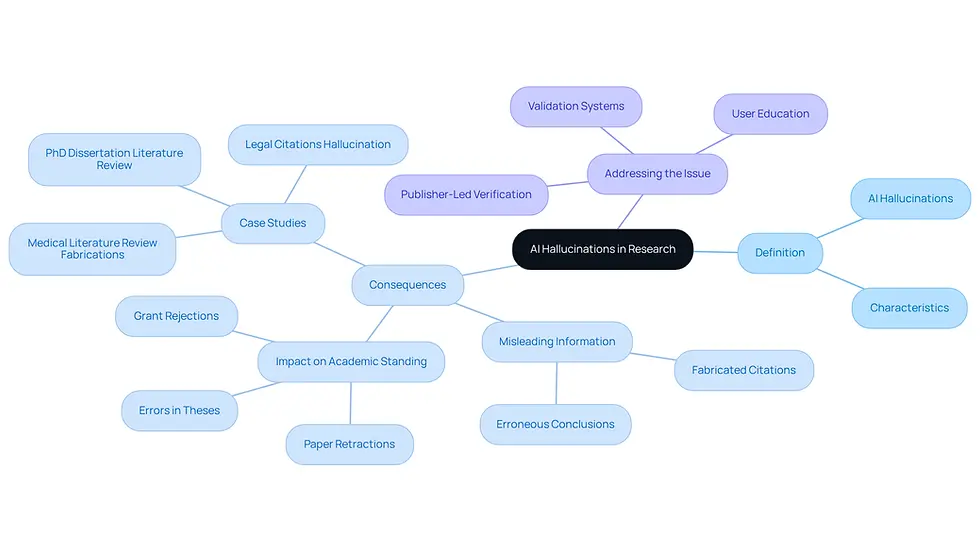
AI hallucination in undergraduate research poses a significant challenge, as it results in the generation of misleading information by artificial intelligence systems, particularly large language models (LLMs). These inaccuracies manifest as fabricated information, erroneous citations, or nonsensical conclusions. Such issues pose significant risks to both researchers and students.
The consequences of AI hallucination in undergraduate research are particularly severe. Relying on AI-generated information can lead to errors in theses or projects, jeopardizing academic standing and the credibility of findings. For instance, a PhD student utilizing AI for a literature review may spend 20-30 hours verifying citations, especially considering that studies indicate up to 37% of DOIs in scholarly content fail. Furthermore, documented cases reveal that fabricated citations have led to paper retractions and grant rejections.
Addressing AI hallucination in undergraduate research is essential for maintaining the integrity of academic research and ensuring the credibility of scholarly findings.
Identify Causes of AI Hallucinations in Academic Contexts
AI hallucination in undergraduate research poses significant challenges, particularly in academic environments. One main reason is the quality of training information; if the information used to train AI systems is biased, incomplete, or outdated, the outputs produced may reflect these shortcomings. Moreover, the complexity of language models may result in overfitting, causing the AI to be overly specific to its training data and struggle to generalize. This pressure can lead to hasty decisions that overlook necessary verification processes, increasing the likelihood of hallucinations.
For example, a student may use an AI tool to generate literature reviews quickly, inadvertently including fabricated studies that do not exist. Understanding these causes is vital for developing effective strategies to mitigate their impact on AI hallucination in undergraduate research.

Implement Best Practices for Mitigating AI Hallucinations
AI hallucinations present significant challenges in undergraduate research, necessitating effective mitigation strategies:
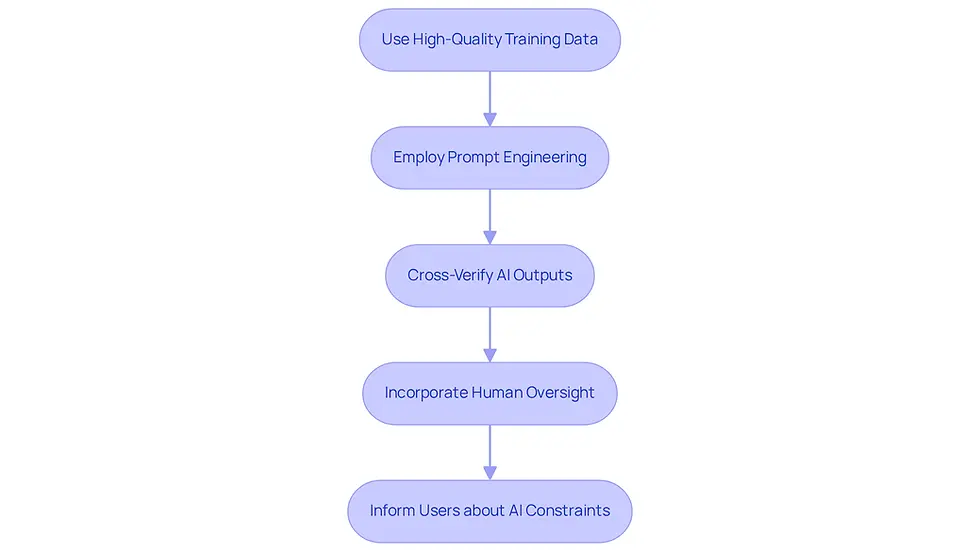
Use High-Quality Training Data: Ensure that AI systems are trained on diverse, accurate, and up-to-date datasets. High-quality training data reduces the likelihood of misleading results, as generative AI models often replicate patterns from their training material without discerning truth. A 2025 analysis found that specialized legal AI tools hallucinated more than 17% of the time, highlighting the critical need for quality data.
Employ Prompt Engineering: Craft specific and detailed prompts when interacting with AI tools. Clear instructions can guide the AI to produce more relevant and accurate responses, thereby minimizing the chances of hallucination. Techniques such as 'chain of thought' prompting can enhance the quality of AI outputs by exposing logical gaps in reasoning. As Yiannis Kiachopoulos noted, "If those pages don’t make it into the model’s top-K context window, the model will either answer narrowly or hallucinate to fill the gaps."
Cross-Verify AI Outputs: Always validate AI-generated content against reliable sources. This involves checking facts against peer-reviewed articles or established databases to ensure accuracy. A study discovered that general-purpose AI chatbots fabricated responses on 58-82% of legal inquiries, emphasizing the importance of verification in high-stakes situations.
Incorporate Human Oversight: Encourage faculty and students to critically review AI outputs. Human judgment is essential in identifying potential inaccuracies that AI may overlook, as generative AI can produce plausible but incorrect information. Such oversight is vital for preserving academic integrity.
Inform Users about AI Constraints: Offer training sessions for students and faculty on the limitations of AI tools, highlighting the significance of critical thinking and verification in inquiry processes. Understanding that AI systems can perpetuate biases and inaccuracies is vital for responsible usage.
By adopting these practices, academic institutions can cultivate a more dependable inquiry environment, significantly minimizing the risks linked to AI hallucination in undergraduate research. Implementing these best practices is essential for safeguarding the integrity of academic research in an increasingly AI-driven landscape.
Establish Validation and Verification Protocols
To ensure the reliability of AI-generated content in undergraduate research, institutions must adopt rigorous validation and verification protocols:
Develop Clear Verification Guidelines: Institutions should create standardized guidelines for verifying AI outputs, including criteria for assessing source credibility and information accuracy. This structured approach improves the integrity of study findings. Notably, 82.8% of AI reviews were misclassified as human-written by the GPTzero detection tool, illustrating the challenges in distinguishing AI-generated content from human-written work.
Implement Peer Review Processes: Encouraging a peer review system allows students and faculty to evaluate each other's work, including AI-generated content. Working together helps spot inaccuracies and improve quality, as peer review has proven to enhance the credibility of studies by verifying data accuracy. Notably, ASM Journals strengthened their generative AI policy in June 2024, reflecting the evolving landscape of AI in research.
Utilize Technology for Verification: Leveraging technology tools can significantly aid in verifying AI outputs. For example, plagiarism detection software can identify unoriginal content, while advanced fact-checking tools can validate claims made in AI-generated texts, ensuring that conclusions are based on precise and authentic information. Tools like SymGen, developed by MIT researchers, assist users in verifying AI model responses more efficiently, further enhancing the verification process.
Conduct Regular Training and Workshops: Organizing training sessions for faculty and students on the significance of validation and verification in scholarly work is essential. These workshops will enhance their skills in critically assessing AI outputs and understanding the implications of AI hallucination in undergraduate research, thereby fostering a culture of integrity in inquiry.
Monitor and Update Protocols: Regularly reviewing and updating validation protocols is essential to adapt to new advancements in AI technology and academic practices. This ensures that the protocols remain relevant and effective in addressing emerging challenges, thereby maintaining high standards of academic integrity. A case study on the 'Impact of Data Verification on Study Credibility' illustrates how thorough verification processes enhance study credibility by confirming data accuracy.
By prioritizing these protocols, institutions can safeguard the integrity of their research and foster a culture of excellence.

Conclusion
Addressing AI hallucination in undergraduate research is essential to uphold academic integrity and trustworthiness. These hallucinations can spread inaccurate information, undermining students' learning experiences and eroding trust in academic research. By grasping how AI hallucinations work, researchers can take proactive steps to reduce their impact and ensure their work remains credible.
The article highlights several key strategies to combat AI hallucinations effectively:
Utilize high-quality training data.
Employ prompt engineering.
Cross-verify AI outputs.
Incorporate human oversight.
Inform users about AI constraints.
Additionally, establishing rigorous validation and verification protocols can significantly enhance the reliability of AI-generated content. These measures not only protect academic integrity but also empower students and faculty to engage critically with AI technologies.
As AI's role in research expands, academic institutions must prioritize implementing these best practices. By fostering a culture of verification and critical assessment, researchers can navigate the complexities of AI tools while safeguarding the quality and credibility of their work. By prioritizing these strategies, academic institutions can ensure that research remains credible and impactful in an increasingly AI-driven landscape.
Frequently Asked Questions
What are AI hallucinations in the context of undergraduate research?
AI hallucinations refer to the generation of misleading information by artificial intelligence systems, particularly large language models (LLMs), which can result in fabricated information, erroneous citations, or nonsensical conclusions.
What are the risks associated with AI hallucinations in research?
The risks include errors in theses or projects, jeopardizing academic standing, and undermining the credibility of findings. This can lead to significant consequences for both researchers and students.
How much time might a PhD student spend verifying citations due to AI hallucinations?
A PhD student may spend 20-30 hours verifying citations, especially since studies indicate that up to 37% of DOIs in scholarly content may fail.
What are some documented consequences of relying on AI-generated information?
Relying on AI-generated information has led to paper retractions and grant rejections due to fabricated citations.
Why is it important to address AI hallucination in undergraduate research?
Addressing AI hallucination is essential for maintaining the integrity of academic research and ensuring the credibility of scholarly findings.
List of Sources
Define AI Hallucinations and Their Impact on Research New sources of inaccuracy? A conceptual framework for studying AI hallucinations | HKS Misinformation Review (https://misinforeview.hks.harvard.edu/article/new-sources-of-inaccuracy-a-conceptual-framework-for-studying-ai-hallucinations) AI Hallucinations in Research: What They Are & How to Stop (https://inra.ai/blog/ai-hallucinations) Hallucinations in generative AI: A threat to scholarly integrity and the urgent need for publisher-led academically supervised verification (https://sciencedirect.com/science/article/abs/pii/S221462962600191X) Major research into ‘hallucinating’ generative models advances reliability of artificial intelligence (https://ox.ac.uk/news/2024-06-20-major-research-hallucinating-generative-models-advances-reliability-artificial)
Identify Causes of AI Hallucinations in Academic Contexts AI hallucinations are slipping past experts into papers and books to enter the permanent record | Fortune (https://fortune.com/2026/05/24/ai-hallucinations-scientific-research-authors-medical-journal-treatment) AI Hallucinations Matter for More Than Academic Integrity (https://centerforengagedlearning.org/ai-hallucinations-matter-for-more-than-academic-integrity) When AI Gets It Wrong: Addressing AI Hallucinations and Bias - MIT Sloan Teaching & Learning Technologies (https://mitsloanedtech.mit.edu/ai/basics/addressing-ai-hallucinations-and-bias) What Are AI Hallucinations? | IBM (https://ibm.com/think/topics/ai-hallucinations) Distinguishing Fact from Fiction: Student Traits, Attitudes, and AI Hallucination Detection in Business School Assessment (https://scale.stanford.edu/ai/repository/distinguishing-fact-fiction-student-traits-attitudes-and-ai-hallucination-detection)
Implement Best Practices for Mitigating AI Hallucinations Scientists Develop New Algorithm to Spot AI 'Hallucinations' (https://time.com/6989928/ai-artificial-intelligence-hallucinations-prevent) AI Strategies Series: 7 Ways to Overcome Hallucinations (https://insight.factset.com/ai-strategies-series-7-ways-to-overcome-hallucinations) When AI Gets It Wrong: Addressing AI Hallucinations and Bias - MIT Sloan Teaching & Learning Technologies (https://mitsloanedtech.mit.edu/ai/basics/addressing-ai-hallucinations-and-bias) Garbage In, Hallucinations Out: How to Stop AI Hallucinations in Scientific R&D - Causaly (https://causaly.com/blog/how-to-stop-ai-hallucinations-in-scientific-r-d) Solving the Very-Real Problem of AI Hallucination (https://knostic.ai/blog/ai-hallucinations)
Establish Validation and Verification Protocols Making it easier to verify an AI model’s responses (https://news.mit.edu/2024/making-it-easier-verify-ai-models-responses-1021) AI in Peer Review: A Recipe for Disaster or Success? | ASM.org (https://asm.org/articles/2024/november/ai-peer-review-recipe-disaster-success) AI Tricks Peer Review Detection Tools 82% Of The Time, Threatening Scientific Integrity (https://studyfinds.com/ai-tricks-peer-review-detection) AI is transforming peer review — and many scientists are worried (https://nature.com/articles/d41586-025-00894-7) The Role of Data Verification in Ensuring Credibility of Research Reports (https://trider.uk/data-verification-ensuring-research-report-credibility)



Comments