
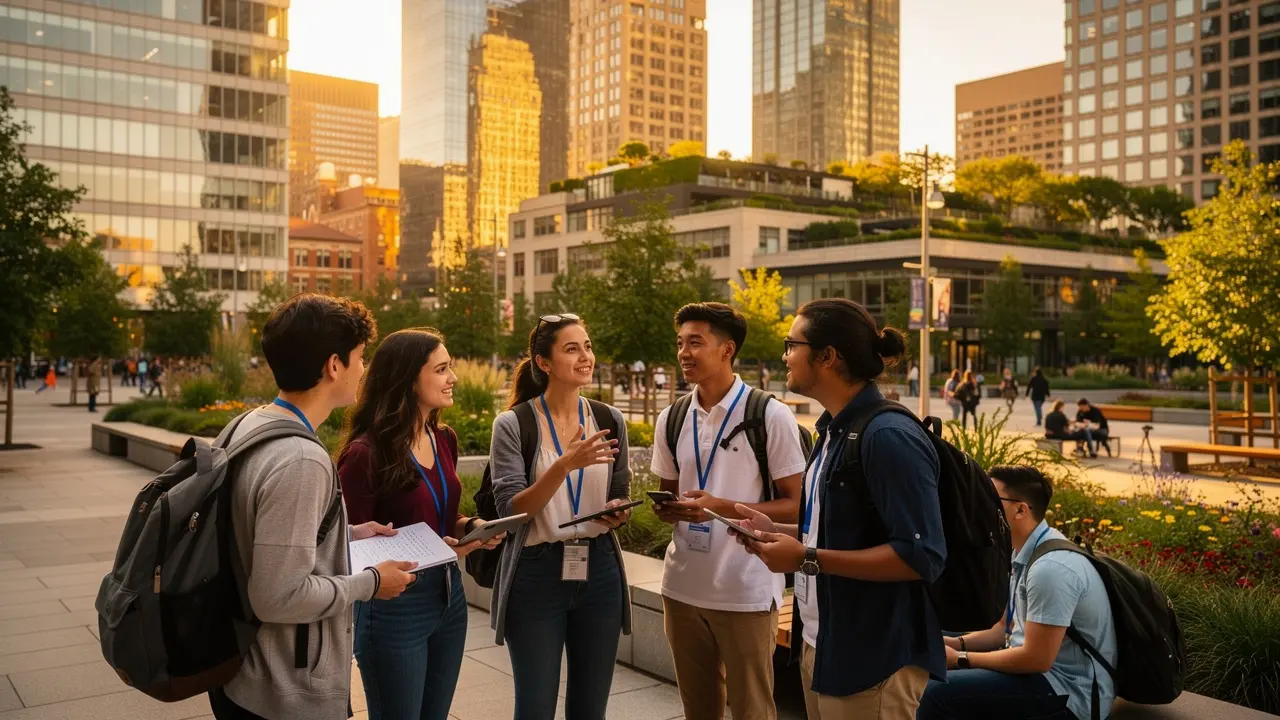
Navigating Undergraduate Research Opportunities in Urban Planning

Introduction
Urban planning is essential for addressing the complex challenges faced by modern cities, making it a critical area of study for aspiring professionals. Engaging in research within this dynamic field not only enhances academic understanding but also equips undergraduate students with practical skills to tackle real-world issues.
With numerous opportunities available, aspiring urban planners must learn to navigate this landscape effectively to secure meaningful research positions that will shape their careers.
Explore the Landscape of Urban Planning Research Opportunities
Urban development offers numerous undergraduate research opportunities in urban planning that are essential for tackling contemporary urban challenges. To effectively navigate these opportunities, consider the following steps:
Identify Key Areas of Interest: Urban development encompasses essential topics such as sustainable growth, transportation, housing, and community engagement. Reflect on which areas resonate with your academic and professional goals.
Academic Institutions and Programs: Explore universities and academic organizations that focus on city planning. Resources such as Planetizen offer listings of internships and study opportunities, assisting you in discovering programs that align with your interests.
Engage with Current Studies: Familiarize yourself with ongoing projects by reading academic journals, attending seminars, and following relevant news in city studies. For example, the Journal of Planning History highlights the impacts of freeway construction and urban renewal, showcasing how these developments have reshaped communities and created economic disparities. Additionally, the lack of reliable data directly imperils the ability of local planners to develop sound plans, as noted by Jon DePaolis, APA’s senior editor.
Explore Funding Opportunities: Numerous projects provide stipends or financial support for undergraduate scholars. Programs such as the Urban Studies Research Program at Stanford University offer financial assistance for student-led initiatives, thereby creating undergraduate research opportunities in urban planning and facilitating involvement in significant inquiries.
Engage with Faculty: Faculty members frequently spearhead scholarly initiatives and can offer valuable advice on how to participate. Examine faculty profiles on university sites to discover their areas of interest and recent publications, which can assist you in identifying potential mentors and collaborators.
Recent statistics indicate that rising housing costs are making homeownership increasingly unaffordable for many American families, with reports showing that this trend is exacerbated by climate change and extreme weather events. The ongoing housing affordability crisis presents significant challenges for urban planners and communities alike. For instance, the case study on the Housing Affordability Crisis illustrates the pressing challenges faced by many communities. By participating in undergraduate research opportunities in urban planning, students can contribute to innovative solutions that address these pressing urban issues. Moreover, the forthcoming SACRPH 2026 conference offers a great chance for students to connect with professionals and interact with contemporary studies in the field.

Identify Potential Research Opportunities in Urban Planning
Identifying undergraduate research opportunities in urban planning can be challenging, yet employing targeted strategies can streamline the process. Consider the following approaches:
Utilize Online Job Boards: Platforms such as the Planetizen Jobs Board list various positions in urban planning related to studies. Use specific keywords to filter your search for relevant opportunities.
Explore University Websites: Many universities maintain dedicated pages for scholarly initiatives. For instance, the University of Florida's Department of Urban and Regional Planning offers insights into ongoing projects and highlights undergraduate research opportunities in urban planning for student engagement.
Network with Peers: Connect with fellow students and alumni who have engaged in project work. Their experiences can provide practical insights and suggestions for applying to research positions.
Participate in Conferences and Workshops: Attending city development conferences, such as the recent Planning Research & Practice Conference, introduces participants to diverse study initiatives and fosters connections with field experts. These events frequently emphasize current challenges and opportunities in city development, as noted by Abhinav Alakshendra regarding the dynamic nature of development studies.
Follow Relevant Social Media Groups: Join online communities and forums centered on city development. Platforms such as Reddit's city development subreddit often share job listings and academic opportunities, making them a valuable asset for aspiring scholars.
Numerous job openings in city development research will be available in July 2026, reflecting the increasing demand for skilled professionals in this field. For instance, roles like Preservation Technician and Design Planner II are presently being promoted, highlighting the variety of positions within city development. Furthermore, the University of Florida is poised to introduce Florida's first dedicated undergraduate degree in development studies in fall 2026, which will enhance undergraduate research opportunities in urban planning and better equip students for the changing challenges in the sector. As the field evolves, staying informed and proactive will be essential for aspiring urban planners to thrive in their careers.

Prepare Your Application Materials for Research Positions
Navigating the competitive landscape of urban planning applications can be daunting, but following these essential steps can significantly enhance your chances of success:
Create a Strong Resume: Highlight pertinent coursework, skills, and any previous experience in studies. Customize your resume to demonstrate your enthusiasm for city development and investigation, ensuring it showcases your written and visual communication skills. Be sure to include the analytical and communication skills you've developed through your studies and work experience, as these are highly valued by employers.
Compose an Engaging Cover Letter: Your cover letter should express your passion for city development and clarify your interest in the particular study opportunity. Highlight relevant skills and experiences that position you as a strong candidate. A well-structured cover letter typically includes an introduction, body, and conclusion, connecting your motivations to the organization's mission. Aim for brevity; hiring managers report that three hundred words or less is the ideal length for a cover letter. Customizing your cover letter to avoid generic applications is crucial.
Gather Letters of Recommendation: Request letters from professors or professionals who can attest to your abilities and potential as a researcher. Provide them with details about the position and your aspirations to help them craft a personalized letter that strengthens your application.
Prepare a Writing Sample: If required, submit a writing sample that demonstrates your analytical and writing skills. This could be a scholarly article or project report related to city development, showcasing your capability to convey intricate concepts effectively.
Review Application Guidelines: Thoroughly read the application instructions for each position. Ensure that you meet all requirements and submit your materials before the deadline. Attention to detail in adhering to guidelines can greatly improve your chances of success in the competitive area of city development studies. Additionally, researching the organization’s goals before applying is essential for tailoring your application materials effectively.
Reflect on the Career Outlook: Keep in mind that the city development profession is expected to expand by 11% from 2018 to 2028, indicating a positive trend in job prospects. This growth highlights why it's crucial to prepare strong application materials that help you stand out in a competitive job market.
By adhering to these steps and incorporating insights from successful case studies, like those from the LA City Open Data Portal, you can enhance your application materials and increase your chances of obtaining a position in city development.

Network with Faculty and Professionals in Urban Planning
In the competitive field of city development, effective networking is crucial for securing research prospects. Here are steps to effectively network, enhanced by Coltie's innovative features:
Attend Networking Events: Participate in workshops, seminars, and conferences such as the National Planning Conference and Urban Future. These events provide opportunities to meet faculty and industry professionals. With Coltie, you can easily find relevant events and connect with attendees through its intelligent matching system, making networking more accessible.
Join Professional Organizations: Become a member of organizations like the American Planning Association. Membership often provides access to exclusive networking events and resources. With Coltie, you can enhance your profile and showcase your interests to attract potential mentors and collaborators.
Utilize Social Media: Platforms like LinkedIn can be powerful tools for connecting with professionals in urban planning. Follow relevant organizations and engage with their content to increase your visibility. Coltie's video profiles allow you to present yourself dynamically, making it easier for others to connect with you.
Request Informational Interviews: Reach out to faculty members or professionals in the field to request informational interviews. Prepare insightful questions to learn about their studies and career paths. Coltie's platform allows you to view faculty profiles, including their areas of interest and advising styles, facilitating more informed outreach.
Follow Up: After meeting someone, send a thank-you email expressing your appreciation for their time. This not only strengthens your connection but also keeps you on their radar for future opportunities. Utilizing Coltie's features can help you maintain these connections by reminding you of important follow-ups and interactions. Neglecting to network can result in missed opportunities that could significantly impact your career in urban planning.

Follow Up on Your Research Applications
Following up on your study applications is essential for enhancing your candidacy in competitive academic environments. Here’s how to do it effectively:
Wait for the Appropriate Time: Allow at least one to two weeks after submitting your application before following up. Waiting too long to follow up may result in missed opportunities, as this timeframe gives faculty members adequate time to review applications thoroughly.
Craft a Professional Email: Compose a concise email directed to the faculty member or hiring manager. Clearly express your continued interest in the position and politely inquire about the status of your application.
Reiterate Your Interest: In your follow-up email, briefly emphasize your enthusiasm for the position and how your skills align with the project. This not only highlights your fit for the role but also echoes the insights from Coltie's sessions on application preparation.
Be Respectful of Their Time: Acknowledge that faculty members may have busy schedules and thank them for considering your application. This demonstrates professionalism and respect for their time, a principle emphasized in Coltie's guidance.
Keep It Short and Sweet: Ensure your follow-up is brief and focused. Avoid lengthy explanations; instead, concentrate on your main message to facilitate a quick understanding of your intent.
A well-timed follow-up can greatly enhance your chances of securing a position, making it a vital step in the application process. As Ben Nemeroff advises, "Your follow-up message should be brief and to the point, allowing the employer to quickly understand your intent without taking up too much of their time." By adhering to these best practices, including Erin Kennedy's suggestion to wait a week before following up, you can effectively navigate the competitive landscape of undergraduate research opportunities in urban planning while utilizing the resources and insights provided by Coltie. Ultimately, a strategic follow-up can be the difference between being remembered and being forgotten in the application process.

Conclusion
For students aspiring to make a meaningful impact in urban planning, understanding and pursuing undergraduate research opportunities is crucial. Research engagement enhances academic knowledge and equips students with practical skills essential for tackling urban challenges. By seeking these opportunities, students can become informed contributors to urban development.
The article outlines several key strategies for identifying and securing research positions:
Explore academic institutions.
Network with faculty.
Prepare compelling application materials.
It emphasizes the importance of understanding current trends in urban planning research and highlights the value of financial support and mentorship in fostering student involvement. Additionally, effective follow-up communication is underscored as a crucial step in the application process.
The pursuit of undergraduate research opportunities in urban planning shapes the future of cities and communities. By taking these proactive steps, students can significantly influence urban planning's future and foster sustainable community development.
Frequently Asked Questions
What are the key areas of interest in urban planning research?
Key areas of interest in urban planning research include sustainable growth, transportation, housing, and community engagement.
How can I find academic institutions and programs focused on urban planning?
You can explore universities and academic organizations that specialize in city planning. Resources like Planetizen provide listings of internships and study opportunities to help you discover relevant programs.
What steps can I take to engage with current studies in urban planning?
To engage with current studies, read academic journals, attend seminars, and follow news in city studies. Journals like the Journal of Planning History provide insights into the impacts of urban developments.
Are there funding opportunities available for undergraduate research in urban planning?
Yes, many projects offer stipends or financial support for undergraduate scholars. For example, the Urban Studies Research Program at Stanford University provides financial assistance for student-led initiatives.
How can I connect with faculty members in urban planning?
You can engage with faculty members by examining their profiles on university websites to learn about their areas of interest and recent publications, which can help you identify potential mentors and collaborators.
What challenges are urban planners currently facing regarding housing?
Rising housing costs are making homeownership increasingly unaffordable for many American families, a trend exacerbated by climate change and extreme weather events, leading to a housing affordability crisis.
How can I identify potential research opportunities in urban planning?
You can identify research opportunities by utilizing online job boards, exploring university websites, networking with peers, participating in conferences and workshops, and following relevant social media groups.
What upcoming events can help students connect with professionals in urban planning?
The forthcoming SACRPH 2026 conference offers a great opportunity for students to connect with professionals and engage with contemporary studies in the field of urban planning.
What new developments are expected in urban planning education?
The University of Florida is set to introduce Florida's first dedicated undergraduate degree in development studies in fall 2026, which will enhance research opportunities and better prepare students for challenges in the sector.
List of Sources
Explore the Landscape of Urban Planning Research Opportunities 8 Urban Planning Trends Shaping Our Future Cities - IEREK (https://ierek.com/news/8-urban-planning-trends-shaping-our-future-cities) The Latest Urban Planning News (https://planetizen.com/news) sacrph.org (https://sacrph.org) 7 Need-to-Know Trends for Planners in 2026 (https://planning.org/planning/2025/dec/7-need-to-know-trends-for-planners-in-2026) 8 trends that will shape cities in 2026 (https://smartcitiesdive.com/news/8-trends-shape-cities-2026-transportation-housing-public-safety-climate/809096)
Identify Potential Research Opportunities in Urban Planning News | Harvard Mellon Urban Initiative (https://mellonurbanism.harvard.edu/news) UF prepares next generation of planners for Florida’s growth challenges (https://news.ufl.edu/2026/04/urban-regional-planning) Urban Planning Jobs Board (https://planetizen.com/jobs) Home | Next City Jobs – Next City (https://jobs.nextcity.org)
Prepare Your Application Materials for Research Positions How to Write a Good Cover Letter for a Research Position | Earthlab (https://earthlab.colorado.edu/blog/how-write-good-cover-letter-research-position) Resumes and Cover Letters for Future Planners (https://planetizen.com/blogs/99481-resumes-and-cover-letters-future-planners) Guides: Urban and Regional Planning: Data Sources and Databases (https://libguides.library.cpp.edu/urp/home) Urban Planning Salary and Career Outlook (https://teach.com/online-ed/government-degrees/online-masters-urban-planning/salary-and-career-outlook) Major Trends in Career Documents – Cover Letters & Personal Statements (2026) (https://beyondberea.org/blog/2026/03/26/major-trends-in-career-documents-cover-letters-personal-statements-2026)
Network with Faculty and Professionals in Urban Planning Urban Planning Events Board (https://planetizen.com/events) National Planning Conference (https://planning.org/conference) For Your Calendar: Recommended Urban Planning Conferences 2025-2026 (https://urbansolutionsjournal.substack.com/p/for-your-calendar-recommended-urban) Next City Vanguard Conference - Urban Leadership Gathering (https://nextcity.org/vanguard) Conferences & Events – Planners Network (https://plannersnetwork.org/events)
Follow Up on Your Research Applications How to follow up on job applications to get interviews (https://joinhandshake.com/blog/students/how-to-follow-up-on-job-applications) How to Follow Up on a Job Application: Key Tips to Show Your Interest (https://coursera.org/articles/how-to-follow-up-on-job-application) Case Study: Driving Diversity in Tech Success | Artech (https://artech.com/blog/job-application-follow-up-best-practices-for-success) Job Application Follow-up Timing and Best Practices | Erin Kennedy posted on the topic | LinkedIn (https://linkedin.com/posts/erinkennedycprw_when-is-the-right-time-to-follow-up-after-activity-7444703479077466112-HSXY)



Comments