

Understanding the Research Experience Guide for Engineering Students

Updated: Aug 15
Introduction
As engineering education transforms, the integration of research experiences is crucial for student development. The Research Experience Guide for Engineering Students serves as an essential tool, providing structured pathways to enhance engagement in inquiry and develop critical skills. Students often struggle to find effective strategies for utilizing the Research Experience Guide, and without proper guidance, they risk falling behind in their academic and professional journeys.
Define the Research Experience Guide for Engineering Students
The research experience guide for engineering students offers essential resources and strategies to enhance student engagement in inquiry activities. This research experience guide for engineering students offers crucial insights on recognizing scholarly interests, forming relationships with faculty mentors, and engaging in projects that align with academic and career goals.
By utilizing Coltie's Research Portfolio Management, which offers integrated, automatically updated faculty and lab profiles, learners can access real-time information about ongoing projects.
These updates, including brief videos and team posts, create valuable connections among learners, alumni, and industry partners, enhancing the overall research experience.
Recent studies emphasize the transformative influence of undergraduate experiences (UREs) on learners, particularly in STEM fields. For instance, a report from the National Academies of Sciences, Engineering, and Medicine highlights the importance of structured UREs in increasing retention and promoting disciplinary knowledge. Statistics indicate that the National Science Foundation (NSF) assists around 6,000 undergraduates in experiential learning each year, underscoring the significance of these opportunities in developing future engineers.
This research experience guide for engineering students clarifies the expectations and benefits of engaging in inquiry, nurturing a culture of exploration and innovation in engineering education, and equipping students for future success.

Contextualize the Importance of the Research Experience Guide in Engineering Education
In engineering education, the integration of investigative experiences is increasingly recognized as vital for a well-rounded academic curriculum. The research experience guide for engineering students serves as a crucial resource, providing organized assistance for individuals embarking on their investigative journeys. Engaging in inquiry enhances technical skills while also developing critical thinking, problem-solving, and teamwork.
Research shows that students involved in undergraduate inquiry experiences (UREs) tend to graduate with STEM degrees at higher rates and often continue to advanced studies. For instance, a study by Craney et al. found that 98.5% of undergraduates in a summer study program graduated within five years, compared to an overall rate of 82%. This statistic underscores the positive impact of study experiences on graduation rates.
Furthermore, practical experiences often lead to internships and job opportunities in competitive fields, shaping individuals' career paths. Case studies, such as the Freshman Research Initiative at The University of Texas at Austin, demonstrate that students completing organized inquiry sequences are more likely to graduate with STEM degrees within six years, particularly among historically underrepresented groups who achieve at rates comparable to their peers.
As noted by the National Academies of Sciences, Engineering, and Medicine, 'a wide range of outcomes have been proposed as potential benefits of UREs for learners, for faculty, and for the institution as a whole.'
The manual acts as a research experience guide for engineering students by providing a structured roadmap that ensures learners can maximize the benefits of their involvement, ultimately aiding in their overall academic performance and significantly influencing career trajectories in STEM fields.

Explore Key Components and Characteristics of the Research Experience Guide
Engaging students in research requires a structured approach that addresses key components essential for their success:
Mentorship Opportunities: Research shows that students who engage with mentors experience a remarkable 72% retention rate, compared to just 49% for those who do not. This statistic underscores the vital role mentorship plays in promoting learner success.
The research experience guide for engineering students provides a curated list of potential fields relevant to engineering disciplines, allowing learners to explore and pinpoint their specific interests. This targeted approach assists learners in aligning their academic pursuits with their career aspirations.
Funding and Resources: The research experience guide for engineering students details various funding options, grants, and materials available to support learners in their academic endeavors. Access to financial assistance is crucial, as it can alleviate barriers that might hinder participation in academic activities.
Skill Development: Workshops and training sessions are included to enhance essential research skills, such as data analysis, technical writing, and presentation skills. These skill-building opportunities are vital for equipping learners for both academic and professional success.
The research experience guide for engineering students facilitates events and platforms that encourage individuals to connect with peers, faculty, and industry professionals. Such networking fosters collaboration and knowledge sharing, which are essential for a well-rounded academic experience.
Ultimately, a well-rounded support system can transform students' academic experiences and outcomes in engineering disciplines.

Provide Examples of Utilizing the Research Experience Guide in Engineering Studies
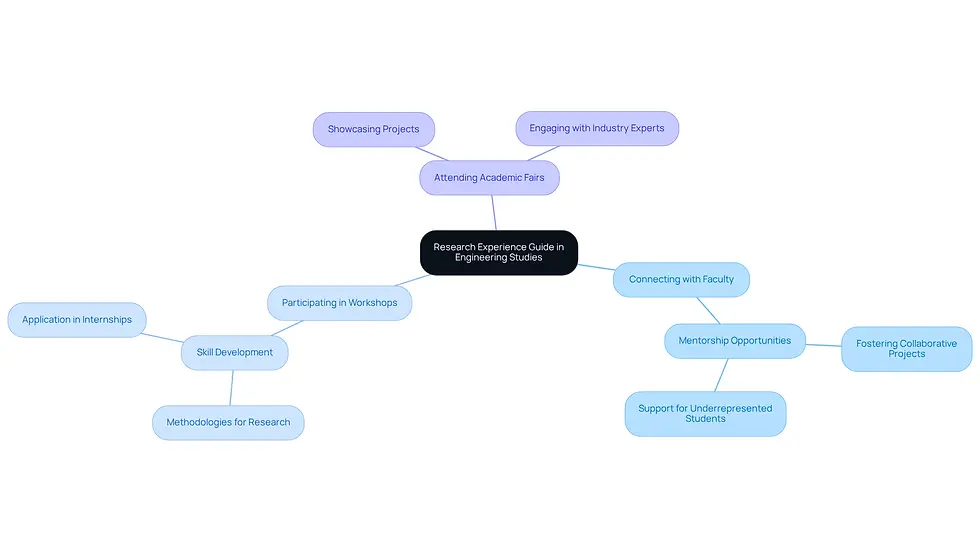
Navigating the complexities of research opportunities can be daunting for engineering students, yet the Research Experience Guide serves as a crucial tool in this journey. This guide is tailored to meet the distinct academic and professional goals of engineering individuals. For instance, an individual enthusiastic about renewable energy can leverage the resource to connect with faculty involved in relevant studies, fostering a mentorship that may lead to collaborative projects. Research indicates that effective mentoring positively influences the persistence of underrepresented individuals in STEM fields, highlighting the importance of such connections.
Additionally, consider an individual participating in a workshop featured in the manual, where they acquire essential methodologies that they later apply during a summer internship at a national laboratory. These experiences play a vital role in honing the divergent thinking skills that engineering education promotes, fostering creativity and exploration in problem-solving.
Moreover, universities frequently organize academic fairs advertised through the manual, providing students with opportunities to showcase their projects and engage with industry experts. These instances underscore the guide's role as a practical resource, empowering students to navigate their research paths effectively and contribute significantly to their fields. Ultimately, the guide not only facilitates individual growth but also fosters a more inclusive and innovative engineering community.
Conclusion
The research experience guide is essential for engineering students seeking to enhance their academic engagement and foster a culture of inquiry. By offering structured support and essential strategies, this guide empowers students to navigate their research journeys and align their academic pursuits with their career aspirations.
Throughout the article, we explored key components of the guide, including:
Mentorship opportunities
Funding resources
Skill development workshops
Networking platforms
Each of these elements plays a crucial role in enriching the research experience, ultimately leading to improved retention rates and higher graduation outcomes for engineering students. The guide facilitates individual growth while promoting collaboration and innovation in the engineering community.
Many engineering students face challenges in accessing the right resources and support for their research endeavors. In light of the significant impact that research experiences have on shaping the careers of future engineers, it is essential for students to actively engage with the resources provided by the research experience guide. By leveraging these opportunities, engineering students can enhance their skills, build valuable connections, and contribute to a more inclusive and innovative field. Engaging with the research experience guide is not merely an academic task; it is a crucial step toward becoming a successful engineer in a dynamic and evolving field.
Frequently Asked Questions
What is the purpose of the research experience guide for engineering students?
The guide offers essential resources and strategies to enhance student engagement in inquiry activities, helping students recognize scholarly interests, form relationships with faculty mentors, and engage in projects that align with their academic and career goals.
How does Coltie's Research Portfolio Management benefit engineering students?
Coltie's Research Portfolio Management provides integrated, automatically updated faculty and lab profiles, allowing students to access real-time information about ongoing projects, which enhances their research experience.
What types of updates does Coltie's platform provide?
The platform includes brief videos and team posts that create valuable connections among learners, alumni, and industry partners.
What is the significance of undergraduate research experiences (UREs) in STEM fields?
Recent studies highlight that structured UREs significantly increase retention and promote disciplinary knowledge among learners, particularly in STEM fields.
How many undergraduates does the National Science Foundation (NSF) assist with experiential learning each year?
The NSF assists around 6,000 undergraduates in experiential learning each year, emphasizing the importance of these opportunities in developing future engineers.
What are the expected benefits of engaging in inquiry for engineering students?
Engaging in inquiry nurtures a culture of exploration and innovation in engineering education and equips students for future success.
List of Sources
Define the Research Experience Guide for Engineering Students How Undergraduates Benefit From Doing Research (https://usnews.com/education/best-colleges/articles/how-undergraduates-benefit-from-doing-research) NSF Research Experiences for Undergraduates (https://nsf.gov/funding/initiatives/reu) Impact of Engineering Research Experience Programs on Domestic and International Undergraduate Students - The Council on Undergraduate Research (https://cur.org/journal-article/impact-of-engineering-research-experience-programs-on-domestic-and-international-undergraduate-students) New Report Examines the Impact of Undergraduate Research Experiences for STEM Students (https://nationalacademies.org/news/new-report-examines-the-impact-of-undergraduate-research-experiences-for-stem-students)
Contextualize the Importance of the Research Experience Guide in Engineering Education Three-Year Study of the Impact of a Research Experience Program in Aerospace Engineering on Undergraduate Students - The Council on Undergraduate Research (https://cur.org/journal-article/three-year-study-of-the-impact-of-a-research-experience-program-in-aerospace-engineering-on-undergraduate-students) Infusing Real World Experiences into Engineering Education 2012 (https://nationalacademies.org/publications/18184) Read (https://nationalacademies.org/read/24622/chapter/6) New Report Examines the Impact of Undergraduate Research Experiences for STEM Students (https://nationalacademies.org/news/new-report-examines-the-impact-of-undergraduate-research-experiences-for-stem-students)
Explore Key Components and Characteristics of the Research Experience Guide New independent work guides help students complete 'signature' Princeton experience (https://princeton.edu/news/2013/11/05/new-independent-work-guides-help-students-complete-signature-princeton-experience) 40+ Definitive Mentorship Statistics and Research for 2025 | MentorcliQ (https://mentorcliq.com/blog/mentoring-stats) New program centers mentorship, culture in research groups | Cornell Chronicle (https://news.cornell.edu/stories/2025/12/new-program-centers-mentorship-culture-research-groups) Mentoring Statistics You Need to Know - 2026 (https://mentorloop.com/blog/mentoring-statistics)
Provide Examples of Utilizing the Research Experience Guide in Engineering Studies Impact of Engineering Research Experience Programs on Domestic and International Undergraduate Students - The Council on Undergraduate Research (https://cur.org/journal-article/impact-of-engineering-research-experience-programs-on-domestic-and-international-undergraduate-students) New Report Examines the Impact of Undergraduate Research Experiences for STEM Students (https://nationalacademies.org/news/new-report-examines-the-impact-of-undergraduate-research-experiences-for-stem-students) Advancing creativity and mentorship in engineering education (https://news.engin.umich.edu/2020/05/advancing-creativity-and-mentorship-in-engineering-education) Research in the Real World: Undergraduate Experiences Shape a New Generation of Innovators (https://linkedin.com/pulse/research-real-world-undergraduate-experiences-7vw2e)



Comments