

4 Best Ways for Transfer Students to Join a Research Lab

Updated: Sep 1
Introduction
Many transfer students encounter significant challenges when transitioning to new academic environments, particularly in securing research lab positions. The right research experience is crucial for enhancing academic journeys and career prospects, but many students struggle to find suitable opportunities. This article outlines four effective strategies that help transfer students connect with research labs:
Use platforms like Coltie for tailored matches.
Improve outreach and networking skills.
Leverage university resources and faculty connections.
Participate in relevant workshops and seminars.
By implementing these strategies, students can transform their challenges into opportunities that propel their academic and professional growth.
Utilize Coltie for Intelligent Matching with Research Labs
Finding the right lab can be a daunting task for students aiming to align their academic pursuits with career aspirations. Coltie's smart matching system is specifically designed to link learners with facilities that correspond with their academic goals and career ambitions. By developing a thorough profile that outlines your academic history, areas of focus, and career objectives, you can leverage Coltie's advanced algorithms to find labs actively seeking students with your qualifications. This tailored approach:
Streamlines the search process
Increases the chances of finding a lab that meets specific needs
Additionally, the platform provides:
Access to faculty profiles
Highlights of their areas of expertise
Insights into advising styles, making it easier to identify potential mentors
Coltie continually evolves its platform to strengthen academic connections. Institutions leveraging intelligent matching systems like Coltie report:
Improved engagement and retention rates
56.1% of internship participants receiving full-time job offers
Enhanced academic outcomes
This innovative approach not only facilitates better matches but also contributes to higher success rates in securing employment post-internship.

Define Your Research Interests Clearly
Without a clear understanding of your academic interests, finding the right laboratory can be a daunting task. Begin by reflecting on the subjects that genuinely excite you, and write down specific questions or topics that spark your curiosity. This clarity enhances your search and positions you as a more appealing candidate to potential mentors. A brief declaration that highlights your passions and their significance to various laboratories is essential. This statement will serve as a powerful tool when reaching out to professors and applying for positions, ensuring that you present yourself as a motivated and focused candidate.
Studies show that learners who participate in investigations frequently attain higher GPAs and retention rates, highlighting the significance of matching preferences with laboratory opportunities. For example, learners motivated to express their academic experiences have effectively recognized shared themes that direct their pursuit of inquiry opportunities, resulting in more significant placements. By dedicating time to clarify your academic focuses, you not only improve your opportunities of discovering an appropriate lab but also set yourself up for increased scholarly achievement and personal development. Ultimately, this clarity can significantly enhance your academic journey and professional development.

Reach Out to Professors and Faculty Members
Connecting with professors can be a daunting task for students, yet it is a crucial step in engaging with scholarly activities. One effective approach is to reach out directly to faculty members whose work aligns with your interests. Start by thoroughly investigating faculty within your department to identify those whose research resonates with you. When contacting them, craft a brief and professional email that introduces yourself, highlights your interest in their work, and inquires about potential study opportunities. Be sure to mention any relevant coursework or experience that demonstrates your preparedness for research roles.
A well-structured email should include:
A clear subject line
A respectful greeting, such as 'Dear Professor Last Name'
A specific request
Aim for a length of 150 to 250 words, focusing on clarity and relevance to respect the professor's time. Customizing your outreach by referencing specific projects or papers can significantly enhance your response rates. For instance, individuals who effectively connected with professors through personalized communication have seen positive results.
Coltie provides tools that help students find relevant information and connect with professors more effectively. Features like the Opportunity Planner and Event Management tools facilitate organized communication and scheduling, further assisting individuals in their outreach efforts. Statistics indicate that effective outreach can lead to higher engagement, with personalized emails yielding better responses. For example, a PhD candidate named Raj improved his response rate from 4% to 80% by implementing a structured email system that emphasized clarity and demonstrated value. This method fosters meaningful discussions and opens doors to potential roles in scientific facilities, making it essential for students looking to enhance their academic journey.

Network with Peers and Faculty for Opportunities
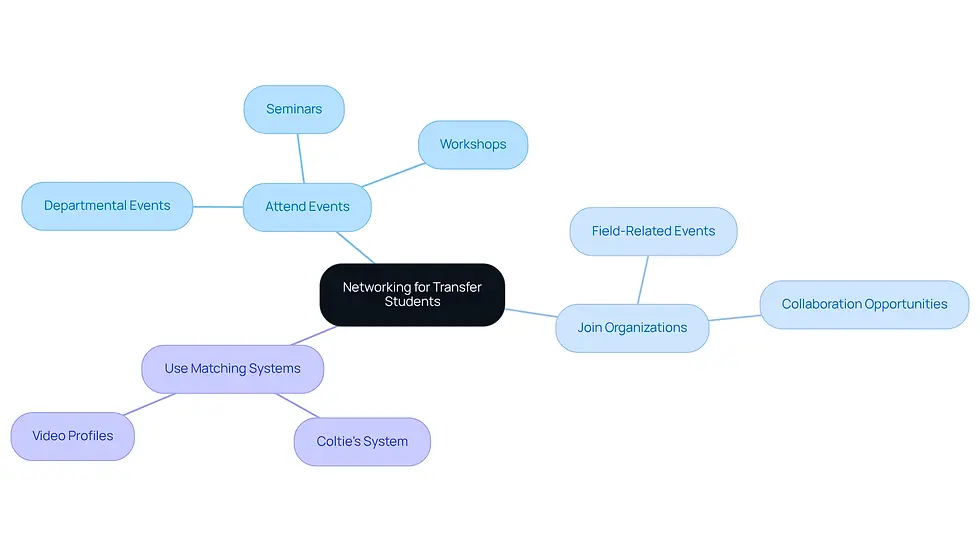
Effective networking is among the best ways for transfer students to join a research lab. Attend departmental events, seminars, and workshops to connect with peers and faculty members. These gatherings provide opportunities to meet faculty and gain insights into their research. Additionally, consider joining organizations relevant to your field, as they often host networking events and facilitate collaboration. A strong network can provide insider information about the best ways for transfer students to join a research lab, along with endorsements from faculty, significantly enhancing your chances of securing a laboratory position.
Coltie's matching system connects candidates with graduate advisors who share their academic interests, streamlining the networking process. Moreover, creating and viewing video profiles enables students to authentically present themselves and understand faculty research and advising styles, fostering deeper academic connections.
Conclusion
For transfer students, finding a research lab can significantly impact their academic and professional trajectories. By utilizing platforms like Coltie, clearly defining research interests, reaching out to faculty, and actively networking, students can enhance their chances of securing valuable research opportunities that align with their goals.
The article outlines four essential strategies:
Leveraging Coltie for intelligent lab matching
Articulating clear research interests
Effectively contacting professors
Engaging in networking activities
Each of these approaches streamlines the process of finding a suitable lab and positions students as proactive and motivated candidates, ready to contribute to meaningful research.
Ultimately, joining a research lab is about building connections, gaining valuable insights, and developing skills that will benefit students long after they leave academia. Taking these steps not only opens doors to research opportunities but also lays the groundwork for future success in their careers.
Frequently Asked Questions
What is Coltie and what does it offer?
Coltie is a smart matching system designed to connect students with research labs that align with their academic goals and career aspirations.
How does Coltie help students find the right lab?
Coltie helps students by allowing them to create a detailed profile that includes their academic history, areas of focus, and career objectives, which the platform uses to match them with labs seeking students with similar qualifications.
What are the benefits of using Coltie for lab matching?
The benefits include streamlining the search process and increasing the chances of finding a lab that meets specific needs.
What additional resources does Coltie provide to users?
Coltie provides access to faculty profiles, highlights their areas of expertise, and offers insights into advising styles to help students identify potential mentors.
How does Coltie contribute to academic success?
Institutions using Coltie's intelligent matching systems report improved engagement and retention rates, with 56.1% of internship participants receiving full-time job offers and enhanced academic outcomes.
What impact does Coltie have on employment after internships?
Coltie's innovative approach facilitates better matches between students and labs, contributing to higher success rates in securing employment post-internship.
List of Sources
Utilize Coltie for Intelligent Matching with Research Labs 5 Best Ways for Honors Students to Join a Research Lab (https://coltie.com/post/5-best-ways-for-honors-students-to-join-a-research-lab) Comparing Cognitive Science Research Opportunities for Undergraduates (https://coltie.com/post/comparing-cognitive-science-research-opportunities-for-undergraduates) Intelligent matching methods for educational resources under a multimodal deep learning framework (https://sciencedirect.com/science/article/pii/S2772941926000347) 10 Undergraduate Research Opportunities for Biology Students (https://coltie.com/post/10-undergraduate-research-opportunities-for-biology-students)
Define Your Research Interests Clearly What New Research Reveals About Student Success (https://insidehighered.com/news/student-success/college-experience/2026/08/18/what-new-research-reveals-about-student-success) Identify Your Research Interests (https://ur.arizona.edu/getting-started/first-steps/identify-your-research-interests) The Importance of Research for University Students (https://linkedin.com/pulse/importance-research-university-students-amena-shahid-dba-mba-ba-yo2lc) The Importance of Statistics | Global Campus (https://mtu.edu/globalcampus/programs/degrees/applied-statistics/articles/importanceofstats)
Reach Out to Professors and Faculty Members 2026 How to Email a Professor the Right Way | Research.com (https://research.com/student-guides/student-success/how-to-email-a-professor-the-right-way) PhDs - how to get 80% response rates from professors instead of being ignored for months. | Emmanuel Tsekleves (https://linkedin.com/posts/emmanueltsekleves_phd-postdoc-academia-activity-7370796840285339649-a_fO) Cracking Cold Emails: Reaching Out to Professors in a Way that Works (https://pcur.princeton.edu/2025/04/cracking-cold-emails-reaching-out-to-professors-in-a-way-that-works) | Security Research Group (https://uvasrg.github.io/prospective) Contacting Faculty About Research Opportunities (https://careers.tufts.edu/blog/2025/09/16/contacting-faculty-about-research-opportunities)
Network with Peers and Faculty for Opportunities Top 10 Effective Networking Tips for Students (https://unfc.ca/blog/networking-tips-for-students) Human connections in a machine age: Why networking in college matters more than ever (https://lakeforest.edu/news-and-events/human-connections-in-a-machine-age-why-networking-in-college-matters-more-than-ever) From Classrooms to Careers: The Power of Academic Networking (https://sacredheart.edu/news-room/news-listing/from-classrooms-to-careers-the-power-of-academic-networking) Academic Networking Tips for College Students: Connecting With Professors and Peers (https://post.edu/blog/academic-networking-tips-for-college-students-connecting-with-professors-and-peers) 8 Ways to Network While You're in College (https://usnews.com/education/best-colleges/articles/ways-to-network-while-youre-in-college)



Comments