

5 Best Ways for Honors Students to Join a Research Lab

Updated: Aug 25
Introduction
Many honors students struggle to find research labs that align with their academic passions and career aspirations. This article presents five effective strategies that can assist students in navigating the complex landscape of research opportunities. This article will address how honors students can identify and secure positions in labs that align with their interests, thereby shaping their academic journeys and future careers.
Utilize Coltie for Intelligent Matching with Research Labs
Many honors students struggle to discover the best ways for honors students to join a research lab that aligns with their academic interests and career goals. Coltie addresses this challenge through its intelligent matching system, connecting students with suitable labs. By creating a detailed profile that highlights your academic background and goals, you receive personalized suggestions for opportunities that fit your aspirations. This tailored approach simplifies the search process and significantly increases the chances of discovering the best ways for honors students to join a research lab that aligns with specific academic interests.
Additionally, the platform allows you to examine faculty profiles, showcasing their areas of expertise and advising methods, enabling informed choices regarding your applications. With 56.1% of internship participants receiving full-time job offers, utilizing Coltie can be a pivotal step in securing a successful career path in your field of study.

Define Your Research Interests Clearly
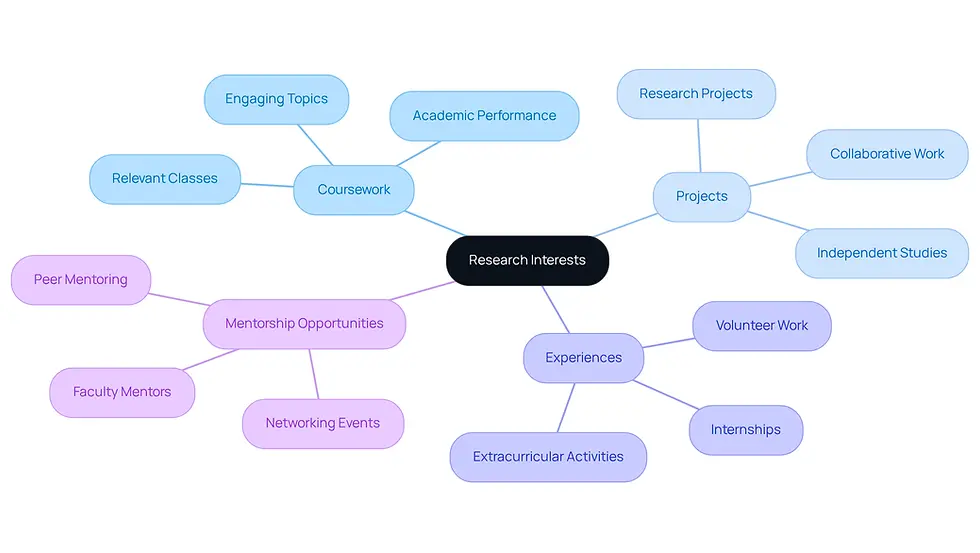
Identifying their research interests is one of the best ways for honors students to join a research lab successfully. Identifying subjects that genuinely interest you is crucial for your academic journey. Consider your coursework, projects, and any relevant experiences that have shaped your academic path. Documenting three to five specific fields of focus will help you discover the best ways for honors students to join a research lab and enhance your ability to connect with potential mentors. A clearly articulated area of study can greatly enhance your eligibility for scholarships and assistant roles, allowing your application to stand out and showcasing your dedication to the discipline.
Research indicates that passionate pursuits can help individuals overcome academic challenges and disabilities. Students with strong enthusiasm for subjects like reading or math engage more deeply with the material than those with high test scores but no passions. Furthermore, 91% of students indicated that their undergraduate scholarly experience strengthened or heightened their enthusiasm for postgraduate education, emphasizing the transformative effect of having a specific academic focus.
Clarifying your academic focuses is one of the best ways for honors students to join a research lab, as it helps direct your studies and conversations with instructors, ultimately influencing your contributions to your field. Ultimately, defining your academic preferences can significantly shape your scholarly trajectory.
Reach Out to Professors for Opportunities
One of the best ways for honors students to join a research lab is by engaging with professors whose research aligns with their academic interests. Start by composing a brief and courteous email that introduces yourself, highlights your academic background, and expresses your interest in their work. Specificity is key; explain why their work resonates with you and how you envision contributing to their lab.
Personalizing your email with context-specific details can significantly enhance your chances of receiving a response, as emails with advanced personalization achieve reply rates of 17-18%. If you do not receive a reply, consider sending a polite follow-up. This not only demonstrates your enthusiasm but also strengthens your dedication to participating in scholarly activities.
Reaching out effectively is one of the best ways for honors students to join a research lab, as it often leads to invaluable mentorship and academic opportunities, as evidenced by students who have successfully connected with faculty through well-crafted emails. For example, a junior Public Health major contacted a professor after being motivated by their lecture, successfully obtaining a position by clearly connecting their passions to the professor's work.
Ultimately, the effort you put into these connections can shape the trajectory of your academic career in profound ways.

Identify Suitable Research Labs for Your Interests
Identifying the right lab is essential for aligning your academic pursuits with your career goals. Consider the following steps:
Explore faculty profiles on your university's website or platforms like Coltie for detailed information about ongoing research projects.
Attend departmental seminars and workshops to learn about current studies and meet faculty members.
Contact current students in those facilities to gain insights into the environment and expectations.
Identifying a lab that aligns with your interests can be a daunting task. Ultimately, this strategic approach can significantly enhance your chances of securing a position in a lab that fits your aspirations.

Conclusion
Finding the right research lab is crucial for honors students seeking to enhance their academic and career prospects. By leveraging tools like Coltie for intelligent matching, clearly defining research interests, effectively reaching out to professors, and identifying suitable labs, students can significantly improve their chances of securing valuable research opportunities. These strategies streamline the search process and foster meaningful connections that shape future academic endeavors.
The article highlights essential methods for honors students, including the importance of creating a detailed profile on platforms like Coltie, which connects students with labs that align with their goals. Additionally, articulating specific research interests allows students to engage more deeply with their academic pursuits, while personalized communication with professors can lead to mentorship and collaborative opportunities. Identifying suitable research labs through proactive exploration and networking further enhances the likelihood of finding a perfect match.
The journey to joining a research lab involves not only securing a position but also cultivating a passion for learning and contributing to the academic community. By taking these proactive steps, honors students can enrich their educational experience and lay a strong foundation for their future careers. By embracing these strategies, students can navigate their academic paths with confidence, ensuring they maximize their research opportunities.
Frequently Asked Questions
What is Coltie and how does it help honors students?
Coltie is a platform that utilizes an intelligent matching system to connect honors students with research labs that align with their academic interests and career goals.
How does the matching process work on Coltie?
Students create a detailed profile highlighting their academic background and goals, which allows Coltie to provide personalized suggestions for research opportunities that fit their aspirations.
What additional features does Coltie offer to students?
Coltie allows students to examine faculty profiles, showcasing their areas of expertise and advising methods, which helps students make informed choices regarding their applications.
What is the success rate of internship participants using Coltie?
56.1% of internship participants using Coltie receive full-time job offers, indicating its effectiveness in helping students secure successful career paths in their fields of study.
List of Sources
Utilize Coltie for Intelligent Matching with Research Labs How Universities Are Measuring Student Engagement in 2026 (https://moderncampus.com/blog/how-universities-are-measuring-student-engagement-in-2026.html) Student Engagement Software Market Research Report 2034 (https://dataintelo.com/report/global-student-engagement-software-market) Student Engagement and Success: 2026 Data, Trends, and Emerging Insights | Lounge Blog (https://about.lounge.live/blog/student-engagement-and-success-2026-data-trends-and-emerging-insights) 25 AI in Education Statistics to Guide Your Learning Strategy in 2026 (https://engageli.com/blog/ai-in-education-statistics) 10 Undergraduate Research Opportunities for Biology Students (https://coltie.com/post/10-undergraduate-research-opportunities-for-biology-students)
Define Your Research Interests Clearly Identify Your Research Interests (https://ur.arizona.edu/getting-started/first-steps/identify-your-research-interests) A Guide to Finding, Writing & Using Them (https://applykite.com/blog/general-guide-everything-about-research-interests) Undergraduate Research: Importance, Benefits, and Challenges - PMC (https://pmc.ncbi.nlm.nih.gov/articles/PMC4739295) How the Power of Interest Drives Learning | KQED (https://kqed.org/mindshift/32503/how-the-power-of-interest-drives-learning) The Importance of Undergraduate Research Experiences - PMC (https://pmc.ncbi.nlm.nih.gov/articles/PMC11287787)
Reach Out to Professors for Opportunities How to Reach Out to Professors (https://exl.cns.utexas.edu/do-research/find-research-lab/how-reach-out-professors) Cracking Cold Emails: Reaching Out to Professors in a Way that Works (https://pcur.princeton.edu/2025/04/cracking-cold-emails-reaching-out-to-professors-in-a-way-that-works) 80 Effective Workplace Communication Quotes for Trainers (https://symondsresearch.com/workplace-communication-quotes) 35 Quotes about Communication to Inspire Collaboration (https://vibe.us/blog/35-quotes-about-communication?srsltid=AfmBOoqLhksJ2740RHzkkf1h1wHDDn6hEhR3P_3zgOBUGhocV8u86ZW5) Cold Email Statistics Based on Sending Over 20M Cold Emails (https://woodpecker.co/blog/cold-email-statistics)
Identify Suitable Research Labs for Your Interests Research & Discovery (https://news.columbia.edu/content/research-discovery) Optimal size and structure of research labs (https://eastonwhite.substack.com/p/optimal-size-and-structure-of-research) 15 US universities with the strongest undergraduate research culture (https://riseglobaleducation.com/blogs/us-universities-strongest-undergraduate-research-culture) News | University of Cincinnati Office of Research (https://research.uc.edu/news) More Research News (https://unlv.edu/research/news)



Comments