

Comparing Undergraduate Research Opportunities in Robotics Programs

Updated: Jun 22
Introduction
Undergraduate research opportunities in robotics present both challenges and opportunities for aspiring professionals in a rapidly evolving field. Students navigating various programs encounter experiences that enhance their technical skills. These skills, along with critical thinking abilities, are essential for success in automation.
With numerous options available, aspiring robotics professionals must discern which programs will best prepare them for future challenges. This article explores the landscape of undergraduate research initiatives in robotics. It highlights key programs, their strengths and weaknesses, and the vital role of industry connections in shaping future careers.
Overview of Undergraduate Research Opportunities in Robotics
Students seeking practical, hands-on experiences in a rapidly evolving field will find that undergraduate research opportunities in robotics present a unique challenge. The Summer Undergraduate Research Opportunities in Robotics at the University of Michigan and the Robotics & Automation Summer School (RASS) at LANL are two notable initiatives that provide students with opportunities to collaborate with leading faculty on innovative projects. RASS, scheduled from May 25 to August 7, 2026, is supported by various initiatives, including the Advanced Recovery and Integrated Extraction System (ARIES) and the Associate Laboratory Directorate for Weapons Engineering. In groups, students will develop rapid prototypes that address critical challenges in automation and technology. The application deadline for RASS is January 10, 2026, with notifications of acceptance sent out by February 5, 2026.
In 2026, many internships and summer undergraduate research opportunities in robotics are available, with platforms like Pathways to Science offering a searchable database of over 600 options specifically for undergraduates interested in automation technology. These programs enhance technical skills while also fostering essential problem-solving and critical thinking abilities. Such skills are vital in the fast-paced robotics sector. Successful internships, such as those focused on designing autonomous vehicles or tracking global storm systems, empower individuals to contribute significantly to their fields while considering advanced degrees. For instance, the 'Tracking Global Storm Systems' project enables participants to leave a significant impact on meteorological research, while the 'Designing Autonomous Cars' initiative positions them at the forefront of automotive innovation.
The focus on practical projects in technology education is essential, as it equips learners for real-world applications and encourages innovation. Ultimately, these experiences not only shape students' careers but also drive innovation in the robotics industry, paving the way for future advancements.

Comparative Analysis of Robotics Research Programs at Leading Universities
Navigating the landscape of automation studies can be challenging for prospective students, given the unique strengths of leading institutions like Carnegie Mellon, MIT, and Stanford. Each of these universities offers distinct advantages that cater to various academic pursuits:
Carnegie Mellon University: Renowned for its Robotics Institute, it provides extensive study opportunities in artificial intelligence and autonomous systems. Dr. Howie Choset emphasizes, "Our focus on real-world applications allows students to engage directly with industry challenges, preparing them for impactful careers in the field of automation."
Massachusetts Institute of Technology (MIT): The Department of Electrical Engineering and Computer Science promotes interdisciplinary study, seamlessly integrating automation with artificial intelligence and machine learning. Dr. Daniela Rus states, "Our research not only advances theoretical knowledge but also translates into practical solutions that can change lives."
Stanford University: Focused on human-robot interaction and robotic perception, Stanford leads in developing innovative technologies that prioritize user experience. Professor Fei-Fei Li observes, "Comprehending how humans and machines can collaborate is essential for the future of automation, and our initiative is committed to investigating this interaction."
In 2026, MIT's automation study initiative continues to thrive, bolstered by substantial funding that enhances its capabilities and outreach. For instance, MIT received $50 million in funding this year, pivotal in advancing projects in autonomous systems and collaborative robotics. The initiative's success stories include advancements in autonomous vehicles and robotic assistants, showcasing its impact on both academia and industry.
Faculty members from these institutions often emphasize the significance of funding and collaboration in advancing their programs. Carnegie Mellon faculty highlight the practical implications of their studies, while MIT faculty discuss the transformative potential of their theoretical work. Conversely, Stanford faculty emphasize the importance of human-centric methods in technology.
Ultimately, a careful evaluation of these factors will empower students to make informed choices that align with their aspirations in the evolving field of automation.

Evaluating Strengths and Weaknesses of Robotics Research Programs
When evaluating automation study initiatives, it is essential to assess the impact of industry connections and funding on educational outcomes. Programs at institutions like Carnegie Mellon stand out due to their robust industry connections and emphasis on practical applications, significantly enhancing job placement rates for graduates. For example, graduates from Carnegie Mellon frequently gain from direct connections to prominent technology companies, facilitating smoother transitions into the workforce and enhancing job placement rates. In contrast, some initiatives may struggle with limited funding for research efforts, which can hinder access to essential hands-on experiences that are critical for skill development. This funding challenge is especially pertinent as entry-level salaries in automation manufacturing often begin at $60,000, making the financial feasibility of these programs a key factor for potential learners and university administrators alike.
MIT promotes innovation through its interdisciplinary approach, but some may find its broad curriculum overwhelming if they prefer a more focused technical education. Meanwhile, Stanford's cutting-edge emphasis on human-robot interaction positions it at the forefront of robotics research, although it may not resonate with those more interested in the technical intricacies of robotics systems.
Recognizing these strengths and weaknesses helps students align their educational paths with their career goals, leading to a more fulfilling academic experience. Alumni feedback emphasizes the significance of practical activities and autonomy encouraged by approved initiatives, as articulated by Nia, a graduate who mentioned, 'I truly believe this endorsed initiative enabled me to engage in more hands-on activities.' It also encouraged me to be more independent and try new methods in difficult situations. As the automation sector continues to advance, the relationships formed during these initiatives will play a crucial role in influencing graduates' career paths. Additionally, initiatives like RoboticsCareer.org are addressing talent acquisition challenges in the field, further emphasizing the importance of industry connections and funding in shaping effective educational programs. Upcoming events like Automate 2026 and the International Manufacturing Technology Show also highlight ongoing advancements in the automation field, making it crucial for learners to remain aware of these opportunities.

Leveraging Platforms for Enhanced Access to Research Opportunities
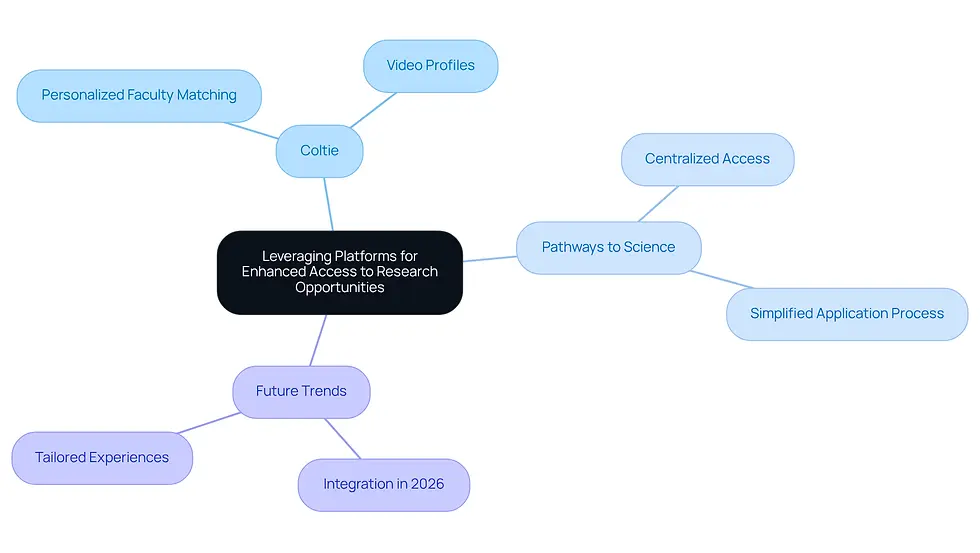
The recruitment landscape in robotics is evolving, and platforms like Coltie are at the forefront of this transformation. Coltie enhances recruitment for learners and academic institutions through personalized faculty matching and detailed video profiles. This approach tackles key challenges in higher education, such as recruitment inefficiencies and the need for personalized connections.
Additionally, resources like Pathways to Science and university-specific portals provide centralized access to internships and academic programs, simplifying the application process. As reliance on digital platforms grows, individuals who effectively leverage these tools can significantly improve their chances of securing valuable research experiences.
In 2026, the integration of such platforms is expected to further transform academic recruitment, creating tailored experiences that align with individual learner needs. As Coltie continues to innovate, it empowers students to navigate their academic journeys with greater autonomy and success.
Conclusion
Navigating the landscape of undergraduate research in robotics can be challenging for students seeking practical experience in a rapidly evolving field. Engaging in research boosts technical skills and helps develop critical thinking and problem-solving abilities, which are crucial for success in the robotics sector.
Key Programs:
University of Michigan: Summer Undergraduate Research Opportunities
LANL: Robotics & Automation Summer School
These programs illustrate the value of hands-on projects. They prepare students for impactful careers and drive innovation in the industry.
The article highlights the strengths and weaknesses of various robotics research programs at leading universities, including Carnegie Mellon, MIT, and Stanford. Each institution offers unique advantages:
Carnegie Mellon: Strong industry connections
MIT: Interdisciplinary approach
Stanford: Focus on human-robot interaction
Understanding these distinctions allows students to make informed decisions that align with their career aspirations, ensuring a more fulfilling academic experience.
As the robotics field continues to evolve, leveraging platforms like Coltie and Pathways to Science can significantly enhance access to research opportunities. Students often struggle to identify the right research programs that align with their career goals. By utilizing these resources, they can navigate their academic journeys more effectively, securing valuable experiences that will shape their future careers. This lack of direction can lead to missed opportunities that could significantly enhance their academic and professional trajectories.
By actively engaging in these research opportunities, students not only advance their careers but also play a vital role in shaping the future of robotics technology.
Frequently Asked Questions
What are the undergraduate research opportunities in robotics mentioned in the article?
The article highlights the Summer Undergraduate Research Opportunities in Robotics at the University of Michigan and the Robotics & Automation Summer School (RASS) at LANL as notable initiatives for students.
What is the schedule for the Robotics & Automation Summer School (RASS)?
RASS is scheduled from May 25 to August 7, 2026.
What is the application deadline for RASS?
The application deadline for RASS is January 10, 2026.
When will notifications of acceptance for RASS be sent out?
Notifications of acceptance for RASS will be sent out by February 5, 2026.
What types of projects do students work on during RASS?
Students work in groups to develop rapid prototypes that address critical challenges in automation and technology.
How many internship and research opportunities in robotics are available in 2026?
In 2026, there are many internships and summer undergraduate research opportunities available, with over 600 options listed on platforms like Pathways to Science.
What skills do these undergraduate research opportunities help develop?
These programs enhance technical skills and foster essential problem-solving and critical thinking abilities, which are vital in the robotics sector.
Can you provide examples of successful internships mentioned in the article?
Examples include internships focused on designing autonomous vehicles and tracking global storm systems.
How do these experiences impact students' careers and the robotics industry?
These experiences shape students' careers, drive innovation in the robotics industry, and pave the way for future advancements.
List of Sources
Overview of Undergraduate Research Opportunities in Robotics Robotics & Automation Summer School (RASS) | LANL (https://lanl.gov/engage/collaboration/internships/summer-schools/robotics-automation-summer-school) Internship and Research Opportunities - The Council on Undergraduate Research (https://cur.org/resources-publications/student-resources/internship-and-research-opportunities) Student research (https://engin.umich.edu/research/student-research) Summer Undergraduate Research Experience in Robotics (https://pathwaystoscience.org/programhub.aspx?sort=SUM-GATech-Robotics)
Comparative Analysis of Robotics Research Programs at Leading Universities World's 100+ best Robotics universities [2026 Rankings] (https://edurank.org/engineering/robotics) QS World University Rankings for Statistics & Operational Research 2026 (https://topuniversities.com/university-subject-rankings/statistics-operational-research) Robotics | MIT News | Massachusetts Institute of Technology (https://news.mit.edu/topic/robotics) DENSO, Carnegie Mellon University to Present Leading AV Research at IEEE's CVPR 2026 (https://prnewswire.com/news-releases/denso-carnegie-mellon-university-to-present-leading-av-research-at-ieees-cvpr-2026-302784566.html) News - Robotics Institute Carnegie Mellon University (https://ri.cmu.edu/news)
Evaluating Strengths and Weaknesses of Robotics Research Programs Techs, Specialists, Integrators - RoboticsCareer.org (https://roboticscareer.org) FANUC America Expands Workforce Development Efforts at SkillsUSA National Conference (https://prnewswire.com/news-releases/fanuc-america-expands-workforce-development-efforts-at-skillsusa-national-conference-302787270.html)
Leveraging Platforms for Enhanced Access to Research Opportunities Bridging Learning and Technology: How Digital Platforms Impact Academic Performance | Journal for Social Science Archives (https://jssarchives.com/index.php/Journal/article/view/154) Frontiers | Robotics in higher education and its impact on digital learning (https://frontiersin.org/journals/computer-science/articles/10.3389/fcomp.2025.1607766/full) Robotics in Higher Education: A Strategic Advantage for Future-Ready Graduates (https://scholaro.com/db/News/the-role-of-robotics-in-college-students-315) Columbia’s New Undergraduate Research Opportunities Platform (UROP) (https://gs.columbia.edu/news/columbias-new-undergraduate-research-opportunities-platform-urop) Faculty duo's app matches faculty and grad students - Inside Iowa State (https://inside.iastate.edu/article/2025/02/06/coltie)



Comments